Showing posts with label 1946. Show all posts

Irving G. Thalberg Memorial Award, 1946

Awards presented March 13, 1947


Samuel Goldwyn
When the glow cast by his Oscar-winning film, The Best Years of Our Lives, still lingered, people -- or at least press agents -- spoke admiringly of "the Goldwyn touch." But today, if he's remembered at all, it's for the malaprop gems known as "Goldwynisms": "Include me out," "Directors always bite the hand that lays the golden egg" and so on. Or else people assume he was one of the heads of the most famous movie studio of them all, Metro-Goldwyn-Mayer. But although Sam Goldwyn almost certainly uttered a few genuine Goldwynisms, most of them were invented by Hollywood gag writers and publicists. And Goldwyn never had anything to do with MGM. That company was created by a merger in 1924 of Metro Pictures with a studio run by Louis B. Mayer and the studio Goldwyn had founded. But he had been ruthlessly elbowed out of Goldwyn Pictures two years earlier.
Those may be the central ironies of Goldwyn's life. He wanted to be remembered as a man of taste, but he lingers in popular history as a buffoon. And he wanted to leave a legacy in his name, but that name was appropriated by a more powerful institution. And irony upon irony, it wasn't even his name to start with, and he had to fight to keep it. He was born Schmuel Gelbfisz, in Warsaw, probably in 1879. He became Samuel Goldfish when he left Poland for England in 1895. The name Goldwyn wasn't created until 20 years later in America, when Sam Goldfish formed a partnership with Edgar and Archibald Selwyn. As Goldwyn's biographer A. Scott Berg explains, "The partners realized that several portmanteau words could be formed from the names Goldfish and Selwyn. . . . In 1916 Goldwyn Pictures was incorporated. . . . For years, show business wags joked about the abandoned syllables of their surnames."
Just as Selfish Pictures wouldn't do, the appellation Sam Goldfish also failed to inspire the respect the company's head wanted. Those of us born to relatively euphonious names can laugh, but it makes perfect sense to me that, when a man named Goldfish receives mail and phone calls for "Samuel Goldwyn," he should decide to make it his legal name. So in 1918, Goldfish became Goldwyn. Five years later, after he was ousted from Goldwyn Pictures, Sam Goldwyn tried to form a company called Samuel Goldwyn, Inc. Goldwyn Pictures Corp. protested that he had no right to the name, which had been the company's before it was his own. Eventually, Judge Learned Hand (who certainly must have known what's in a name) ruled: "A self-made man may prefer a self-made name."
 For there's no more quintessentially American tale than that of the rise of Sam Goldwyn, the epitome of the self-made man. It's a story that would have Horatio Alger goggling. Born in the poverty and despair of the Eastern European ghetto, through pluck and luck Goldwyn amassed an estate that was worth more than $16 million when he died in 1974. And he did it all in an industry that didn't exist -- was undreamed-of -- when he was born.
He was almost present at the creation: He produced the first feature-length film made in Hollywood, The Squaw Man, in 1913. He made his last film, Porgy and Bess, 46 years later. Without having a bit of education, talent or taste, he produced a long string of movies noted for their literacy, skill and finesse. Of course, he knew how to use the education, talent and taste of others -- up to a limit. It's that limit that makes Goldwyn's story so interesting.
As an independent producer in the heyday of the great studios, Goldwyn challenged enormous odds. Until 1947, when the Supreme Court made them sell off their theaters, Paramount, Loew's (MGM's parent company), Warner Bros., Twentieth Century-Fox and RKO owned 70 percent of the first-run theaters in the nation's largest cities. This gave them an obvious advantage: an easy outlet for their own films. Independents such as Goldwyn had to wheel and deal to get their films distributed, and to secure the services of big stars, good directors and technicians, and the rights to plays and novels.
Goldwyn played this game longer than anyone else, and he played it better than everyone except, perhaps, David O. Selznick. Unlike Selznick, Goldwyn never produced a Gone With the Wind, never discovered a star of the magnitude of Ingrid Bergman or a director of the stature of Alfred Hitchcock. On the other hand, Selznick, 20 years younger than Goldwyn and the son of industry pioneer Lewis Selznick, got his start in the big studios before going independent. He also died, a burnt-out case, nearly a decade before Goldwyn.
And even Selznick didn't achieve "the Goldwyn touch," the reputation for excellence that his best films -- Dodsworth and The Best Years of Our Lives -- deserve. Goldwyn did it largely by hounding and driving the people who worked for him, demanding precision and clarity in their films -- and by hiring director William Wyler, who was as persnickety as Goldwyn, often driving actors to tears and rage with his perfectionism.
''Tell me," Wyler asked in 1980, "which pictures have 'the Goldwyn touch' that I didn't direct?" But the Goldwyn touch was also cinematographer Gregg Toland's and set designer Richard Day's and composer Alfred Newman's. The debt Goldwyn owed to them was never acknowledged. Once Goldwyn overheard someone referring to a Goldwyn production as a Wyler film. "I made 'Withering Heights,' " Goldwyn retorted, mispronouncing the title as usual. "Wyler only directed it."
The trouble is, the Goldwyn touch hasn't worn well. His best films are still watchable, but they don't speak to us the way the greatest Hollywood movies do. Dodsworth is an absorbing, literate film, but a minor delight, a second-order classic like a novel by Trollope. Wuthering Heights grabs us with the sheer physical beauty of the young Laurence Olivier and Merle Oberon, but it never scales the demonic heights of Emily Brontë's great mad novel. The Best Years of Our Lives profoundly captured the experience of the generation that fought World War II, but one has to make an imaginative connection with its first audiences to enjoy it today.
What's lacking in Goldwyn's polished, glossy films is personality, the spark that brings to life the great Hollywood movies. They lack the gargantuan egotism of Orson Welles, the lively gregariousness of Howard Hawks, the spacious humanity of John Ford, the delicious perversity of Alfred Hitchcock, the slapstick cynicism of Billy Wilder, the loopy bumptiousness of Preston Sturges. Goldwyn's films try too hard to be perfect. Goldwyn's perfectionism was of the kind that shades over into paranoia, a fear that underlings, unless they are watched and hounded constantly, will goof off -- or worse, intentionally screw up to embarrass the boss. In The Last Tycoon, F. Scott Fitzgerald describes a studio head "with a suspiciousness developed like a muscle." I can believe that he had Goldwyn in mind, for as Berg pointed out, Fitzgerald was brought in to labor on a Goldwyn film, and observed in his notes for The Last Tycoon: "You always knew where you stood with Goldwyn -- nowhere."
But more damaging in the long run is that Goldwyn couldn't trust himself. The self-made man can never go back to what he was before, a child of ghetto poverty, an illegal-immigrant glove salesman, a show-business hustler. Those who knew Goldwyn early were frequently surprised at what he became. His daughter, Ruth, estranged from him after his first marriage disintegrated, observed when she met him some years later that "he seemed almost manufactured." Ben Hecht caricatured him as an almost machine-like assemblage: "The yellow, billiard-ball head, the nutcracker jaws, the flossy tailoring, high-priced cologne, yodeling voice and barricaded eyes that were Sam Goldwyn greeted us en masse." What was barricaded behind those eyes? Perhaps a man whose experiences, whose energy, whose drive, if he had allowed them to be unleashed, could have made better pictures.
Sidney Kingsley's play Dead End, set in a New York street that divided elegant apartments from squalid tenements, was the kind of "prestigious" Broadway production Goldwyn could hardly resist trying to make into a movie. But when filming began, he was enraged when he found the set littered with garbage. The director, William Wyler, patiently explained that the picture was set in a slum. Goldwyn persisted in having it cleaned up. It's certainly not that Goldwyn didn't know what a real slum looked like. Realism was not the issue: "His pictures had a distinctive look about them -- a feel that was always tasteful, even in an East Side slum," Berg noted. The trouble with Goldwyn, finally, is that he didn't have the courage of his own vulgarity.

Honorary Awards, 1946

Awards presented March 13, 1947

To Laurence Olivier for his outstanding achievement as actor, director and producer in bringing Henry V to the screen.
To Harold Russell for bringing hope and courage to his fellow veterans through his appearance in The Best Years of Our Lives
To Ernst Lubitsch for his distinguished contributions to the art of the motion picture
To Claude Jarman, Jr., outstanding child actor of 1946

Best Documentary, 1946

Awards presented March 13, 1947

A paucity of feature-length documentaries left the Academy with only shorts that qualified as nominees. 

The nominees were ... 

(Short Film) 

And the Oscar went to ... 
Seeds of Destiny, United States Department of War.

Effective and often harrowing portrayal of the devastating effect of World War II on civilian populations, especially children, making a sharp contrast with the comparatively unscathed United States. It was designed to encourage support for the United Nations Relief and Rehabilitation Administration. Directed by David Miller and narrated by Ralph Bellamy.


Best Short Films, 1946

Awards presented March 13, 1947

The nominees were ... 

(Cartoon) 
(One-Reel) 
(Two-Reel) 
And the Oscar went to ... 
(Cartoon) 

For the fourth year in a row, William Hanna and Joseph Barbera's Tom and Jerry slaughter the competition -- and each other. The steady violence of these cartoons has gone out of style, partly through the efforts of well-meaning censors but also because of the delicious satire of the "Itchy and Scratchy" parodies on The Simpsons, which shone a light on the essentially unfunny excess of the series. But The Cat Concerto is one of the best of the series: Tom is a concert pianist who awakens Jerry, asleep in the piano, during a performance of Liszt's Hungarian Rhapsody No. 2. Jerry of course tries to sabotage the performance. Scott Bradley, the regular composer for the Tom and Jerry series, does a wonderful job of making hash of the rhapsody. 


(One-Reel) 
Facing Your Danger, Gordon Hollingshead, producer. 
Gordon Hollingshead


A team runs the Colorado River rapids through the Grand Canyon to Lake Mead. A producer for shorts at Warner Bros., Hollingshead won two short-film Oscars this year, bringing his total to four. He would win a fifth. 

(Two-Reel) 
A Boy and His Dog, Gordon Hollingshead, producer.

A rather sugary tale of a boy who rescues an abused dog. When its owner demands that he return it, a magistrate, played by the venerable character actor Harry Davenport, sorts things out. Directed by LeRoy Prinz, who is best known as a choreographer.  

Best Special Effects, 1946

Awards presented March 13, 1947

The nominees were ... 

And the Oscar went to ... 
Blithe Spirit. Special visual effects, Thomas Howard.

A novelist (Rex Harrison) hires a medium (Margaret Rutherford) to hold a séance to gather material for his next book, but discovers that she has summoned up the ghost of his dead wife (Kay Hammond), whom only he can see. On stage Noël Coward's play didn't require any special effects to get the point across, but the film version, directed by David Lean, added Howard's effects, which include some double exposures and objects transported by wires, but also tricks of makeup and lighting to give Hammond a ghostly but glamorous air. It was clearly not a year of great innovation in the effects departments -- the only other nominee, A Stolen Life, relied on conventional masking effects to turn Bette Davis into twins. This was the first of two Oscars for Howard, who had begun his career as an effects artist on The Thief of Bagdad, for which the effects director, Lawrence W. Butler, won an Oscar. A pioneer in front-projection effects, Howard spent his career in England, where he became head of the effects department at MGM's Elstree studios. His later work included 2001: A Space Odyssey, but once again, someone else walked off with the special effects Oscar: director Stanley Kubrick. 
Kay Hammond and Margaret Rutherford in Blithe Spirit
Hammond and Constance Cummings in Blithe Spirit
Rex Harrison and Hammond in Blithe Spirit

Best Film Editing, 1946

Awards presented March 13, 1947

The nominees were ... 
And the Oscar went to ... 

One of unnominated cinematographer Gregg Toland's characteristic deep-focus compositions for The Best Years of Our Lives:  Hoagy Carmichael, Harold Russell, and Fredric March at the piano, Dana Andrews in the phone booth
This was the second of Mandell's three Oscars. Only Ralph Dawson, Michael Kahn, and Thelma Schoonmaker have also won three times. 


Best Music, 1946

Awards presented March 13, 1947

Nowhere did the end of studio-submitted nominees have more impact than in the music categories. For the 1945 awards there were twenty-one nominees for score of a dramatic or comedy picture, twelve for scoring a musical, and fourteen for song. This year there were only five in each category. 


The nominees were ... 
(Music Score of a Dramatic or Comedy Picture)
(Scoring of a Musical Picture) 
(Song) 
And the Oscar went to ... 
(Music Score of a Dramatic or Comedy Picture) 
Hugo Friedhofer, The Best Years of Our Lives. 

Friedhofer began a long association with movie music as an accompanist for silent films in his native San Francisco, then became a studio musician in Los Angeles in 1929. His musicianship attracted the attention of Warner Bros. department head Max Steiner and composer Erich Wolfgang Korngold, and he began working as an orchestrator for them. He also composed incidental music for films, and in 1938 did his first complete score, for The Adventures of Marco Polo. Frustrated by Warners' desire to keep him primarily in the role of arranger and orchestrator, he left the studio to freelance. Alfred Newman, who had worked at the Samuel Goldwyn studios before become head of the 20th Century-Fox music department, recommended Friedhofer to Goldwyn as the composer of the score for The Best Years of Our Lives. It was his only Oscar win out of nine nominations. 

(Scoring of a Musical Picture) 
Morris Stoloff, The Jolson Story. 
Morris Stoloff

Stoloff had been a violin prodigy and one of the youngest members of the Los Angeles Philharmonic before being hired by Paramount as concertmaster for its studio orchestra. In 1936 he moved to Columbia as the studio's first music director, a position that ensured him a string of Oscar nominations, even for films like The Jolson Story on which he didn't actually compose or orchestrate the score -- he racked up seventeen nominations in this position. This was the second of three wins. 

(Song) 
"On the Atchison, Topeka and the Santa Fe," from The Harvey Girls. Music by Harry Warren; Lyrics by Johnny Mercer. 


Judy Garland in The Harvey Girls
Judy Garland stars in a pleasant, brightly colored musical about the waitresses in Fred Harvey's chain of restaurants that were opened to serve passengers on the railroads spanning the United States. The prim and starchy young women compete with the saloon girls for customers, and Garland competes with Angela Lansbury for the attentions of saloon-keeper John Hodiak. This Freed Unit musical, directed by George Sidney, features Garland in fine form and a cast that includes Ray Bolger, Virginia O'Brien, Marjorie Main, Chill Wills, and Cyd Charisse. Except for the Oscar-winning song, the Warren-Mercer score is forgettable, perhaps because Hodiak couldn't sing, so no memorable love songs were written for him and Garland. (Howard Keel had yet to appear as MGM's leading man who could also sing.) It was the first of Mercer's four Oscars, and the last of Warren's three wins. 


... when it should have gone to ... 
(Music Score of a Dramatic or Comedy Picture) 
William Walton, Henry V. 


When it comes to English music, William Walton is often looked on as a bridge between Edward Elgar and Benjamin Britten. Walton broke with the stately Elgar tradition with his early works, including the collaboration with poet Edith Sitwell on Façade, which caused a storm of controversy and labeled him an avant-garde composer. But by 1937 he was so much a part of the mainstream that he was called on to compose a march for the coronation of George VI, since Elgar was dead. And when World War II broke out, he was exempted from military service so he could compose scores for British propaganda films -- the best of which was Laurence Olivier's Henry V. Walton had earlier written the score for Paul Czinner's film of As You Like It, which starred Olivier, and he would collaborate with Olivier on two more Shakespeare films, Hamlet (for which he received his second nomination) and Richard III. In all, he scored thirteen films, but he was dismissive of his work for the movies. Today, the suites that have been arranged from his film scores by others are among his most-performed works. The Henry V score, with its blend of Elizabethan-style themes and stirring mood pieces, remains one of the classics of film music.   
  

Best Sound, 1946

Awards presented March 13, 1947

The nominees were ... 
And the Oscar went to ... 
The Jolson Story. Columbia Studio Sound Department, John Livadary, Sound Director. 

Larry Parks as Al Jolson in The Jolson Story 
Larry Parks plays Al Jolson, the cantor's son who became one of the twentieth century's legendary entertainers. It was a phenomenally popular biopic, but it's not seen much today because Jolson's performing style and the music he sang now seem corny and archaic, and his performances in blackface are downright offensive. In fact, at the time the movie was made, several producers passed on the project for those very reasons. But Columbia boss Harry Cohn had been a song-plugger -- he sang and played the piano in music stores to encourage people to buy sheet music -- back in Jolson's heyday, and was a big fan. The movie is full of biopic clichés and gives no hint that its subject was a temperamental egomaniac. Parks was dubbed in the musical numbers by Jolson himself, which is probably a major reason why the film earned John Livadary the second of his three Oscars. (The actual dubbing work was probably done by the credited sound technicians, Hugh McDowell and Richard Olson, but at this time the Oscar still went to the sound department head.) Parks, who received a nomination for best actor, was a Columbia contract player seen mostly in B-movies until the studio had trouble filling the role of Jolson: James Cagney and Danny Thomas turned down the part -- Thomas reportedly declined because the studio wanted him to have his nose bobbed -- and José Ferrer and Richard Conte were tested for it. Parks also starred in the sequel, Jolson Sings Again, but his climb to stardom was cut short when he was called before the House Un-American Activities Committee and admitted that he had been a member of the Communist Party. His subsequent career was confined to nightclubs, theater, and a handful of TV appearances, but he made one last screen appearance in a supporting role in the 1962 film Freud. 

Best Art Direction, 1946

Awards presented March 13, 1947

Like the cinematographers, the art directors decided to sharply reduce the number of nominees this year -- in their case, to three per category. 


The nominees were ... 
(Black-and-White) 
(Color) 
... when they should have been ... 
(Black-and-White) 
(Color) 
And the Oscar went to ... 
(Black-and-White) 

The lavish decor for the movie sometimes resembles that of a very expensive Thai restaurant. Director John Cromwell had hoped for color, but the studio wouldn't spring for it. Art director Lyle Wheeler got his chance to do it over in color ten years later when it became The King and I, reusing many of the original designs. He won an Oscar for that version, too.  

(Color) 
The Yearling. Art Direction: Cedric Gibbons, Paul Groesse; Interior Decoration: Edwin B. Willis. 

Something of a surprise winner in this category, given that much of the film takes place out of doors and the interiors are the sparsely furnished cabins of impoverished Florida farmers. 

... when it should have gone to ... 
(Black-and-White) 
Alexandre Traunder

Léon Barsacq
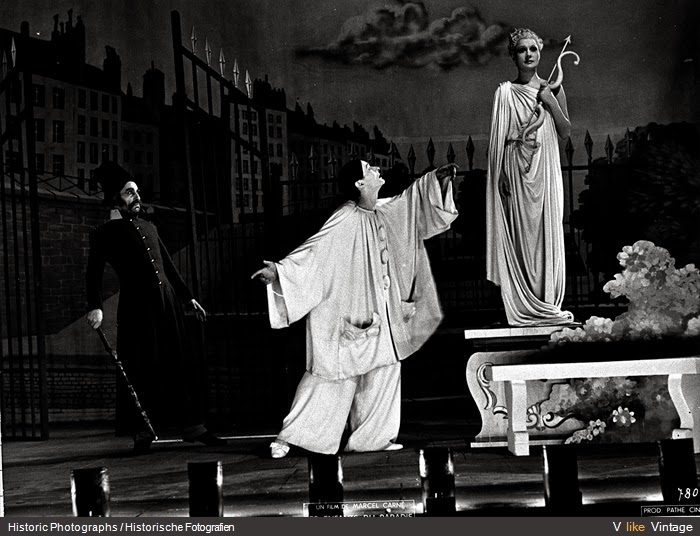
Marcel Carné's brilliant re-creation of the nineteenth-century French theater scene was made under the harshest of conditions under Nazi occupation, including the fact that art director Alexandre Trauner was Jewish, and was forced to hide that fact from the Vichy authorities. Some of the exterior sets had to be completely rebuilt after being damaged by a storm, and throughout the filming materials were in short supply. So the fact that the film was made at all is remarkable enough. That it is truly beautiful as well is miraculous. Barsacq would later be nominated for his work on The Longest Day. Trauner would have a regular working relationship with Billy Wilder and win an Oscar for The Apartment, as well as being nominated for his work with John Huston on The Man Who Would Be King.
Baptiste (Jean-Louis Barrault) gives Garance (Arletty) a role in his latest pantomime 


(Color) 
Henry V. Art Direction: Paul Sheriff, Carmen Dillon.

Carmen Dillon
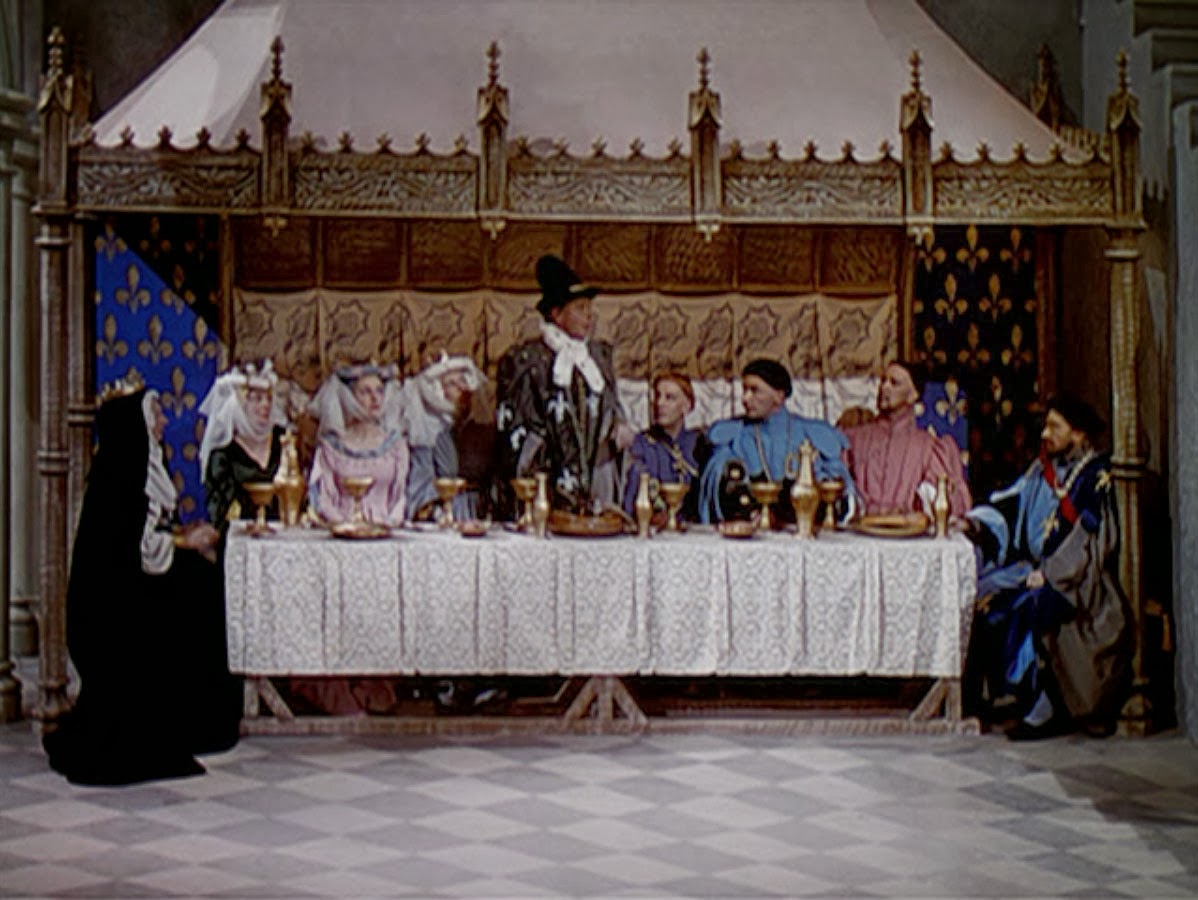
This fine version of Shakespeare's play was originally planned as a wartime morale booster, and it shows director and star Laurence Olivier at his creative best, well-supported by Leo Genn, Felix Aylmer, Robert Newton, Max Adrian, Robert Helpmann, Ernest Thesiger, and Renee Asherson, among many others. But it's also a tribute to the creative work of Paul Sheriff, the Russian-born designer who was the mainstay of many of the British-made films of the 1940s and '50s, and Carmen Dillon, who won an Oscar for Olivier's Hamlet. She also trained many of the British designers who would follow her in the 1960s and '70s, including Oscar winners John Box, Terence Marsh, and Roy Walker. The design of Henry V is something of a tour de force, as the film begins in a re-creation of the Elizabethan Globe theater, then moves into a stylized presentation, and finally into realistic battle scenes. Some of the sets are modeled on the images from the French gothic illuminated manuscript, the Très Riches Heures du Duc de Berry, which was contemporary with the actual King Henry V. 
From the Très Riches Heures du Duc de Berry
Banquet scene in Henry V 
The Chorus (Leslie Banks) on the stage of the Globe in Henry V
A view from the Globe stage in Henry V 
The stylized gates of Harfleur in Henry V
Laurence Olivier as Henry V 


Best Cinematography, 1946

Awards presented March 13, 1947

The Academy made a somewhat radical change of rules this year, putting the several branches of the Academy, instead of the studios and production companies, in charge of the nominations. The Cinematographers Branch had done something like this before: In 1939, it allowed each studio to submit its own candidates, but then had winnowed down the nominees to only two each in the Black-and-White and Color categories. That time, at least the names in the studio "long list" were made public. Now the cinematographers chose to announce only the final two nominees in each category -- a decision that naturally caused some controversy, so the nominees were expanded to the now-customary five per category with the 1949 awards.   

The nominees were ... 
(Black-and-White) 
(Color) 
... when they should have been ... 
(Black-and-White) 
(Color) 
(Black-and-White) 

The musical version of the story of the king and the British governess of his many children is so familiar that you feel a letdown when the songs don't come in this, the first film version, starring Rex Harrison and Irene Dunne. It provided Miller with the third of his three Oscars. He retired as a director of photography in 1951 because of poor health, but remained active in the industry, serving as president of the American Society of Cinematographers. 

(Color) 

Claude Jarman Jr. in The Yearling
In one of the best of the MGM Technicolor "family films" of the 1940s, which include National Velvet and Lassie Come Home, Claude Jarman Jr. plays Jody Baxter, a boy living in the Florida backwoods, who discovers an orphaned fawn and raises it with the encouragement of his father, played by Gregory Peck. But his mother, played by Jane Wyman, struggling with the poverty in which the family lives, regards the animal as just another mouth to feed, especially after it grows and becomes more rambunctious. Some of the film was shot near the home of Marjorie Kinnan Rawlings, who wrote the novel on which the film is based and whose own story was told in the 1983 film Cross Creek. Rosher had received the very first Oscar given for cinematography, for his work on Sunrise. In the 1940s he became a specialist in the lush Technicolor for which MGM films were noted. Smith had received three previous nominations for color cinematography; this was his only Oscar. It was also his last film: He died in October 1947. Arling received a subsequent nomination, for the black-and-white cinematography of I'll Cry Tomorrow, but this was also his only Oscar.  
Jane Wyman in The Yearling 
Gregory Peck and Jarman in The Yearling 
... when it should have gone to ... 
(Black-and-White) 

Ted Tetzlaff
Tetzlaff's only nomination was for The Talk of the Town, but his work with Hitchcock on Notorious deserved more attention from the Academy. He helped craft, for example, the tracking shot in which the camera looks down on the party at the Sebastians from a second-floor balcony and then gradually descends to a shot of the key to the wine cellar in Ingrid Bergman's hand. It's conventional to give Hitchcock the credit for imagining such an effect, but obviously he needed a cinematographer who knew how to light it and a cameraman who knew how to set it up. Tetzlaff, who had been a cinematographer since 1926, and had such credits as My Man Godfrey and The More the Merrier, was more than capable of doing Hitchcock's bidding on this and other "Hitchcockian" scenes. This was, however, his last film as cinematographer: The following year he became a full-time director, though his credits in that job are somewhat less impressive. 
The beginning of the famous tracking shot in Notorious 
Ingrid Bergman waits as the shot is set up
Director Alfred Hitchcock inspects the angle on the concluding shot
The conclusion of the sequence 
In another Notorious sequence, odd camera angles suggest the hangover Bergman experiences when she awakes to find Cary Grant in her bedroom