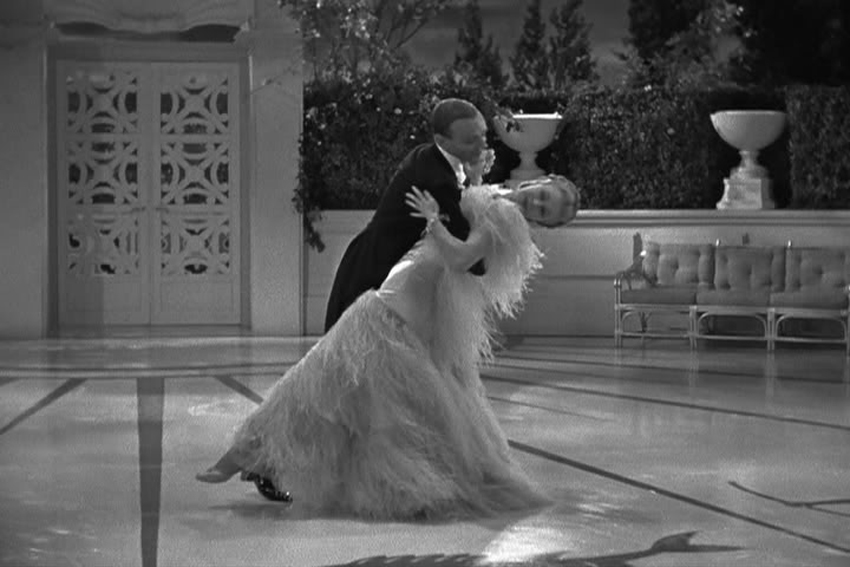
The Academy was still accepting write-ins and indicating who placed second and third. The scores for Mutiny on the Bounty and for write-in candidate Captain Blood came in second and third, respectively. "Cheek to Cheek" was the second-place song and "Lovely to Look" at came in third.
The nominees were ...
(Scoring)
- Captain Blood, Warner Bros.-First National Studio Music Department, Leo Forbstein, head of department (Score by Erich Wolfgang Korngold)
- The Informer, RKO Radio Studio Music Department, Max Steiner, head of department (Score by Max Steiner)
- Mutiny on the Bounty, Metro-Goldwyn-Mayer Studio Music Department, Nat W. Finston, head of department (Score by Herbert Stothart)
- Peter Ibbetson, Paramount Studio Music Department, Irvin Talbot, head of department (Score by Ernst Toch)
- "Cheek to Cheek" from Top Hat, Music and Lyrics by Irving Berlin
- "Lovely to Look At" from Roberta, Music by Jerome Kern; Lyrics by Dorothy Fields and Jimmy McHugh
- "Lullaby of Broadway" from Gold Diggers of 1935, Music by Harry Warren; Lyrics by Al Dubin
And the Oscar went to ...
(Scoring)
The Informer, RKO Radio Studio Music Department, Max Steiner, head of department (Score by Max Steiner).
(Song)
"Lullaby of Broadway" from Gold Diggers of 1935, Music by Harry Warren; Lyrics by Al Dubin.
... when it should have gone to ...
(Scoring)
Captain Blood, Warner Bros.-First National Studio Music Department, Leo Forbstein, head of department (Score by Erich Wolfgang Korngold).
 |
| Erich Wolfgang Korngold |
His name inevitably produced the joke that his music was "more corn than gold," but he was one of the most successful and most admired film composers of his day, eventually winning an Oscar in his own name for The Adventures of Robin Hood (1938) after winning one for Leo Forbstein, the head of the music department at Warners, for Anthony Adverse (1936). (At the time, the Oscar went to the music department head, and not to the composer.) As a child prodigy in Vienna, his early compositions were praised by Gustav Mahler and Richard Strauss. His opera Die tote Stadt, which had its premiere in 1920 when Korngold was twenty-three, was a hit, and was performed at the Metropolitan in New York two years later. After falling out of favor, it has been revived in recent years, and its most familiar aria, "Glück das mir verblieb," originally a duet for soprano and tenor also known as "Mariettas Lied," is frequently performed by sopranos in recitals. Korngold also drew the attention of the Viennese theatrical entrepreneur Max Reinhardt, who collaborated with him on productions of Die Fledermaus and La belle Hélène, and brought him to Hollywood to arrange Felix Mendelssohn's incidental music for A Midsummer Night's Dream when Reinhardt's production was being filmed. Korngold returned to composing and conducting in Vienna, where he wrote the score for Captain Blood, integrating some themes by Franz Liszt with his own, so he declined to be credited as composer. The rise of Hitler and the Anschluss of 1938 drove him into exile in America.
(Song)
 |
| Irving Berlin |
Berlin is, of course, the most famous and admired of all the great songwriters of the 1930s and '40s. But it's easy to undervalue him because of his tendency to sentimentality and hyperpatriotism (both in abundance in the too-familiar "God Bless America," for example). But this song finds him inspired as only a great composer might be by the voice of Fred Astaire and the dancing of Fred and Ginger. Consider the astonishing dramatic shifts in mood and melody found in ''Cheek to Cheek'': The song starts with the dreamy ''Heaven/I'm in heaven'' theme, which it repeats, then breaks into the buoyant ''Oh! I love to climb a mountain'' theme, repeating it (''Oh! I love to go out fishing''). And then, suddenly, there's the ecstatic command to ''Dance with me'' -- before the singer settles back into the first theme: ''The charm about you/Will carry me through/To heaven/I'm in heaven....'' The song may have been written for Astaire and Rogers to dance to, but it stands, or rather dances, on its own.