Showing posts with label All the King's Men. Show all posts

Best Supporting Actress, 1949

Awards presented March 23, 1950
The nominees were ... 
... when they should have been ... 

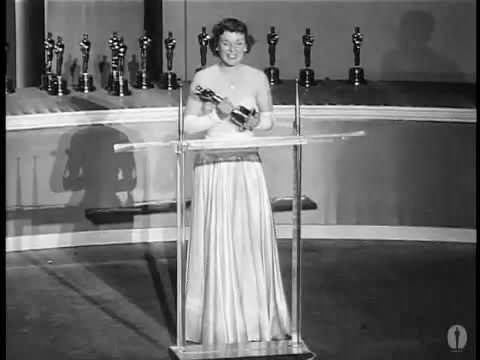
McCambridge accepts her Oscar
McCambridge began her acting career on radio in 1938, and made several appearances on Broadway before her screen debut as Willie Stark's campaign girl Friday in All the King's Men. The Oscar gave her no great career boost, however, and a few roles in minor films and on television followed. Her most memorable role during these years was as the over-the-top villain in Johnny Guitar (1954), Nicholas Ray's eccentric Western starring Joan Crawford; the movie was a flop, but has since, in large part thanks to McCambridge and Crawford, become a cult classic. She received a second Oscar nomination for her role in Giant, but much of her later career was spent in television guest appearances, with frequent appearances on Westerns like Rawhide, Bonanza and Gunsmoke. She returned to Broadway in 1962 to play Martha in Who's Afraid of Virginia Woolf?, replacing Uta Hagen. Her most famous role, however, was unseen: She initially received no billing for her work as the voice of the demon in The Exorcist, but sued Warner Bros. to obtain the screen credit.   
McCambridge, John Ireland, and Broderick Crawford in All the King's Men 

Best Actor, 1949

Awards presented March 23, 1950
The nominees were ... 
... when they should have been ... 

Crawford inherited the "big lug" stereotype of his fellow Oscar winners Wallace Beery and Victor McLaglen, though with somewhat less success than theirs. He is chiefly known for two film roles -- this one and Judy Holliday's junkyard-millionaire sugar daddy in Born Yesterday -- and for "Highway Patrol," the late-1950s TV series that seemed to run forever in syndication. He was the son of two vaudevillians, Lester Crawford and Helen Broderick (best-known for her wise-cracking sidekick roles in the Astaire-Rogers movies Top Hat and Swing Time), and dropped out of Harvard to become a stevedore. He got his first big break when he was cast in the role of Lenny in the 1937 Broadway adaptation of John Steinbeck's Of Mice and Men. He went to Hollywood on the strength of his New York success, but was passed over for the part of Lenny in the film version in favor of Lon Chaney Jr. He found regular work, mostly as a B-picture heavy, until Robert Rossen chose him to play the charismatic Willie Stark -- a role that had been offered first to John Wayne. He landed his other major film role, in Born Yesterday, after Paul Douglas, who had played the part on Broadway, decided not to reprise it in the film. Although he also starred in one of the early films of Federico Fellini, Il Bidone (1955), he failed to find satisfactory work in movies, and turned to TV, where in addition to "Highway Patrol," he had a long career, mostly in guest appearances. Despite severe alcoholism, he managed to work regularly until his death in 1986.    

... when it should have gone to ...  

James Cagney and Margaret Wycherly in White Heat 
If Cagney's Oscar for Yankee Doodle Dandy, in which he played the ultimate song-and-dance man, honored one side of his career, then he certainly should have won for White Heat, which is his gangster apotheosis, a Gangsterdämmerung. He pulls out all the stops and throws them away as Cody Jarrett, the gangster with a fixation on his mother (Margaret Wycherly), who is as ruthless and loony as he is. Directed by Raoul Walsh, everyone in this film noir with a fiery finish gives a terrific performance, even Virginia Mayo, so often the epitome of bland blondness, as Cody's moll, Verna. The movie deservedly made the National Film Registry of the Library of Congress in 2003, but it received only one Oscar nomination, for the story by Virginia Kellogg on which it was based. 

"Made it, Ma! Top of the world!" Cagney's immolation scene in White Heat


Best Picture, 1949

Awards presented March 23, 1950

The nominees were ... 


... when they should have been ...


And the Oscar went to ...
All the King's MenThere were two other strong nominees for this award: The Heiress and A Letter to Three Wives, both of which today are more highly regarded than the winner. Joseph L. Mankiewicz was a double winner for screenplay and directing for A Letter to Three Wives. Did the Academy feel it had to make it up to Robert Rossen, the producer, director, and writer of All the King's Men, by giving him the Oscar for best picture? Broderick Crawford and Mercedes McCambridge also won, as actor and supporting actress respectively.

... when it should have gone to ...
The Bicycle Thief
More properly Bicycle Thieves (Ladri di biciclette), this small masterpiece by Vittorio De Sica is one of the most celebrated films in history. It was a surprise hit in America, and the Academy gave it its then-honorary award for outstanding foreign-language film. David O. Selznick was so impressed by it that he wanted to remake it with Cary Grant in the role played by Lamberto Maggiorani, a non-professional whom De Sica recruited from the streets of Rome. Amazingly, the film stirred controversy when the Production Code Administration refused its seal of approval because of a scene set in a brothel and another in which the small boy urinates against a wall. The ridicule directed at the enforcers for this decision helped undermine the Code's credibility and authority, leading to further challenges throughout the 1950s.