Showing posts with label Carmen Dillon. Show all posts

Best Art Direction, 1948

Awards presented March 24, 1949

And the nominees were ... 
(Black-and-White)

(Color) 
... when they should have been ... 
(Black-and-White) 
(Color) 
And the Oscar went to ... 
(Black-and-White) 
Hamlet. Art direction, Roger K. Furse; set decoration, Carmen Dillon. 

Furse had designed the costumes for Olivier's film of Henry V, but the costume Oscar had not been created yet. He was in luck this year: He also won the first ever black-and-white costume design award for Hamlet. Dillon had been nominated for the sets of Henry V, and would collaborate with Furse and Olivier again on Richard III.  

(Color) 
The Red Shoes. Art direction, Hein Heckroth; set decoration, Arthur Lawson.


Sketches by Hein Heckroth for The Red Shoes
Unlike the cinematographers, who denied Jack Cardiff a nomination and thus a second consecutive win by a Brit in their category, the art directors were not so jingoist, so this was the second Powell-Pressburger film in a row to take the color art direction Oscar. Heckroth had been a set designer for the ballet and theater in Germany, but left because his wife was Jewish. After living in the Netherlands and France, he ended up in England in 1935, where he designed for the opera before going to work for Alexander Korda on the film of Shaw's Caesar and Cleopatra. Unhappy with working for Korda, he was hired away by Alfred Junge, the design director for Powell and Pressburger, and designed the costumes for their A Matter of Life and Death and Black Narcissus. When Junge disagreed with them on the look for The Red Shoes, he quit and was replaced by Heckroth, who was nominated for both sets and costumes for The Tales of Hoffman before returning to Germany in the mid-1950s. This was the only nomination for Lawson, who was a prominent art director in Britain until his death in 1970. 
Moira Shearer and Léonide Massine in The Red Shoes
... when it should have gone to ... 
(Black-and-White) 
Beauty and the Beast. Art direction, Christian Bérard, Carré; set decoration, René Moulaert.


Christian Bérard
Jean Cocteau's La Belle et la bête had its premiere at the Cannes festival in 1946, but was not seen in the United States until December 1947, and didn't receive a release that would qualify it for the Oscars until 1948. The Academy ignored it, however, as it did many foreign contributions to cinematic art, though Christian Bérard's collaboration with Cocteau produced images that remain as haunting today as they were when they first appeared. There was no makeup Oscar at the time, so Hagop Arakelian's magnificent Beast had no place to be admired, although almost everyone agrees that he's a far handsomer being than the somewhat wimpy prince he's revealed to be at the end: As the familiar story has it, Greta Garbo cried out, "Give me back my Beast!" when he's transformed. (A similar reaction occurs to the Disney film, which clearly modeled its Beast on Cocteau's.) Lucien Carré, who was sometimes credited only with his surname, was a French production designer whose career spanned thirty years.

Sketches by Christian Bérard for Beauty and the Beast 
Belle's father (Marcel André) in the Beast's castle
Belle (Josette Day) in the Beast's castle
Day and Jean Marais

Belle and the Prince, released from the spell, are swept away to his kingdom


Best Art Direction, 1946

Awards presented March 13, 1947

Like the cinematographers, the art directors decided to sharply reduce the number of nominees this year -- in their case, to three per category. 


The nominees were ... 
(Black-and-White) 
(Color) 
... when they should have been ... 
(Black-and-White) 
(Color) 
And the Oscar went to ... 
(Black-and-White) 

The lavish decor for the movie sometimes resembles that of a very expensive Thai restaurant. Director John Cromwell had hoped for color, but the studio wouldn't spring for it. Art director Lyle Wheeler got his chance to do it over in color ten years later when it became The King and I, reusing many of the original designs. He won an Oscar for that version, too.  

(Color) 
The Yearling. Art Direction: Cedric Gibbons, Paul Groesse; Interior Decoration: Edwin B. Willis. 

Something of a surprise winner in this category, given that much of the film takes place out of doors and the interiors are the sparsely furnished cabins of impoverished Florida farmers. 

... when it should have gone to ... 
(Black-and-White) 
Alexandre Traunder

Léon Barsacq
Marcel Carné's brilliant re-creation of the nineteenth-century French theater scene was made under the harshest of conditions under Nazi occupation, including the fact that art director Alexandre Trauner was Jewish, and was forced to hide that fact from the Vichy authorities. Some of the exterior sets had to be completely rebuilt after being damaged by a storm, and throughout the filming materials were in short supply. So the fact that the film was made at all is remarkable enough. That it is truly beautiful as well is miraculous. Barsacq would later be nominated for his work on The Longest Day. Trauner would have a regular working relationship with Billy Wilder and win an Oscar for The Apartment, as well as being nominated for his work with John Huston on The Man Who Would Be King.
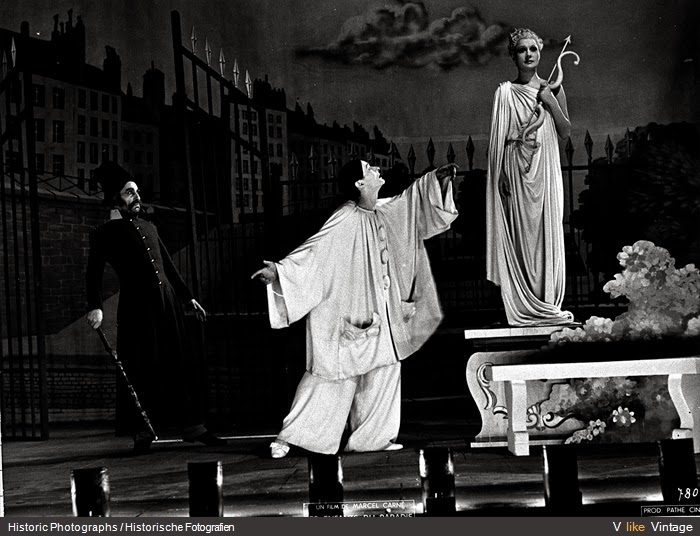
Baptiste (Jean-Louis Barrault) gives Garance (Arletty) a role in his latest pantomime 


(Color) 
Henry V. Art Direction: Paul Sheriff, Carmen Dillon.

Carmen Dillon
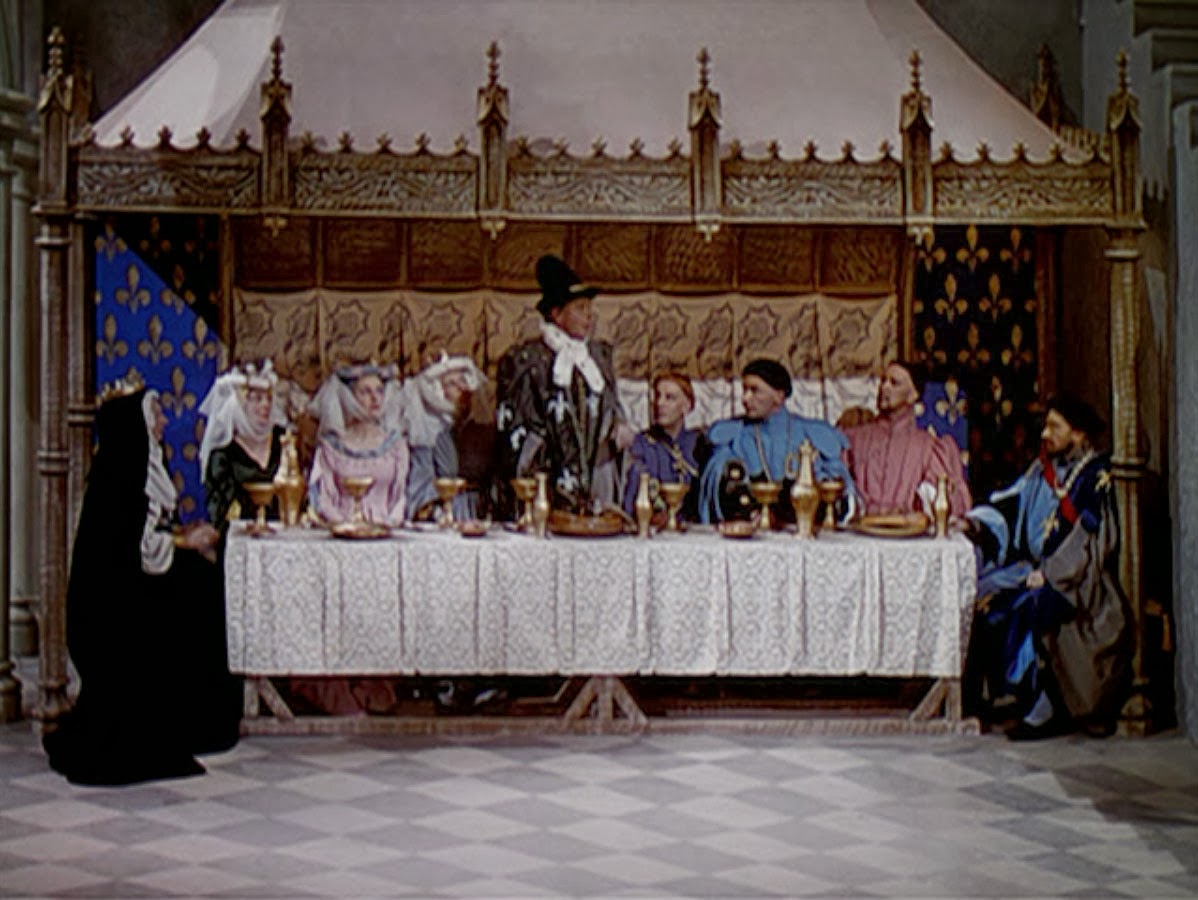
This fine version of Shakespeare's play was originally planned as a wartime morale booster, and it shows director and star Laurence Olivier at his creative best, well-supported by Leo Genn, Felix Aylmer, Robert Newton, Max Adrian, Robert Helpmann, Ernest Thesiger, and Renee Asherson, among many others. But it's also a tribute to the creative work of Paul Sheriff, the Russian-born designer who was the mainstay of many of the British-made films of the 1940s and '50s, and Carmen Dillon, who won an Oscar for Olivier's Hamlet. She also trained many of the British designers who would follow her in the 1960s and '70s, including Oscar winners John Box, Terence Marsh, and Roy Walker. The design of Henry V is something of a tour de force, as the film begins in a re-creation of the Elizabethan Globe theater, then moves into a stylized presentation, and finally into realistic battle scenes. Some of the sets are modeled on the images from the French gothic illuminated manuscript, the Très Riches Heures du Duc de Berry, which was contemporary with the actual King Henry V. 
From the Très Riches Heures du Duc de Berry
Banquet scene in Henry V 
The Chorus (Leslie Banks) on the stage of the Globe in Henry V
A view from the Globe stage in Henry V 
The stylized gates of Harfleur in Henry V
Laurence Olivier as Henry V