Showing posts with label Henry V. Show all posts

Honorary Awards, 1946

Awards presented March 13, 1947

To Laurence Olivier for his outstanding achievement as actor, director and producer in bringing Henry V to the screen.
To Harold Russell for bringing hope and courage to his fellow veterans through his appearance in The Best Years of Our Lives
To Ernst Lubitsch for his distinguished contributions to the art of the motion picture
To Claude Jarman, Jr., outstanding child actor of 1946

Best Music, 1946

Awards presented March 13, 1947

Nowhere did the end of studio-submitted nominees have more impact than in the music categories. For the 1945 awards there were twenty-one nominees for score of a dramatic or comedy picture, twelve for scoring a musical, and fourteen for song. This year there were only five in each category. 


The nominees were ... 
(Music Score of a Dramatic or Comedy Picture)
(Scoring of a Musical Picture) 
(Song) 
And the Oscar went to ... 
(Music Score of a Dramatic or Comedy Picture) 
Hugo Friedhofer, The Best Years of Our Lives. 

Friedhofer began a long association with movie music as an accompanist for silent films in his native San Francisco, then became a studio musician in Los Angeles in 1929. His musicianship attracted the attention of Warner Bros. department head Max Steiner and composer Erich Wolfgang Korngold, and he began working as an orchestrator for them. He also composed incidental music for films, and in 1938 did his first complete score, for The Adventures of Marco Polo. Frustrated by Warners' desire to keep him primarily in the role of arranger and orchestrator, he left the studio to freelance. Alfred Newman, who had worked at the Samuel Goldwyn studios before become head of the 20th Century-Fox music department, recommended Friedhofer to Goldwyn as the composer of the score for The Best Years of Our Lives. It was his only Oscar win out of nine nominations. 

(Scoring of a Musical Picture) 
Morris Stoloff, The Jolson Story. 
Morris Stoloff

Stoloff had been a violin prodigy and one of the youngest members of the Los Angeles Philharmonic before being hired by Paramount as concertmaster for its studio orchestra. In 1936 he moved to Columbia as the studio's first music director, a position that ensured him a string of Oscar nominations, even for films like The Jolson Story on which he didn't actually compose or orchestrate the score -- he racked up seventeen nominations in this position. This was the second of three wins. 

(Song) 
"On the Atchison, Topeka and the Santa Fe," from The Harvey Girls. Music by Harry Warren; Lyrics by Johnny Mercer. 


Judy Garland in The Harvey Girls
Judy Garland stars in a pleasant, brightly colored musical about the waitresses in Fred Harvey's chain of restaurants that were opened to serve passengers on the railroads spanning the United States. The prim and starchy young women compete with the saloon girls for customers, and Garland competes with Angela Lansbury for the attentions of saloon-keeper John Hodiak. This Freed Unit musical, directed by George Sidney, features Garland in fine form and a cast that includes Ray Bolger, Virginia O'Brien, Marjorie Main, Chill Wills, and Cyd Charisse. Except for the Oscar-winning song, the Warren-Mercer score is forgettable, perhaps because Hodiak couldn't sing, so no memorable love songs were written for him and Garland. (Howard Keel had yet to appear as MGM's leading man who could also sing.) It was the first of Mercer's four Oscars, and the last of Warren's three wins. 


... when it should have gone to ... 
(Music Score of a Dramatic or Comedy Picture) 
William Walton, Henry V. 


When it comes to English music, William Walton is often looked on as a bridge between Edward Elgar and Benjamin Britten. Walton broke with the stately Elgar tradition with his early works, including the collaboration with poet Edith Sitwell on Façade, which caused a storm of controversy and labeled him an avant-garde composer. But by 1937 he was so much a part of the mainstream that he was called on to compose a march for the coronation of George VI, since Elgar was dead. And when World War II broke out, he was exempted from military service so he could compose scores for British propaganda films -- the best of which was Laurence Olivier's Henry V. Walton had earlier written the score for Paul Czinner's film of As You Like It, which starred Olivier, and he would collaborate with Olivier on two more Shakespeare films, Hamlet (for which he received his second nomination) and Richard III. In all, he scored thirteen films, but he was dismissive of his work for the movies. Today, the suites that have been arranged from his film scores by others are among his most-performed works. The Henry V score, with its blend of Elizabethan-style themes and stirring mood pieces, remains one of the classics of film music.   
  

Best Art Direction, 1946

Awards presented March 13, 1947

Like the cinematographers, the art directors decided to sharply reduce the number of nominees this year -- in their case, to three per category. 


The nominees were ... 
(Black-and-White) 
(Color) 
... when they should have been ... 
(Black-and-White) 
(Color) 
And the Oscar went to ... 
(Black-and-White) 

The lavish decor for the movie sometimes resembles that of a very expensive Thai restaurant. Director John Cromwell had hoped for color, but the studio wouldn't spring for it. Art director Lyle Wheeler got his chance to do it over in color ten years later when it became The King and I, reusing many of the original designs. He won an Oscar for that version, too.  

(Color) 
The Yearling. Art Direction: Cedric Gibbons, Paul Groesse; Interior Decoration: Edwin B. Willis. 

Something of a surprise winner in this category, given that much of the film takes place out of doors and the interiors are the sparsely furnished cabins of impoverished Florida farmers. 

... when it should have gone to ... 
(Black-and-White) 
Alexandre Traunder

Léon Barsacq
Marcel Carné's brilliant re-creation of the nineteenth-century French theater scene was made under the harshest of conditions under Nazi occupation, including the fact that art director Alexandre Trauner was Jewish, and was forced to hide that fact from the Vichy authorities. Some of the exterior sets had to be completely rebuilt after being damaged by a storm, and throughout the filming materials were in short supply. So the fact that the film was made at all is remarkable enough. That it is truly beautiful as well is miraculous. Barsacq would later be nominated for his work on The Longest Day. Trauner would have a regular working relationship with Billy Wilder and win an Oscar for The Apartment, as well as being nominated for his work with John Huston on The Man Who Would Be King.
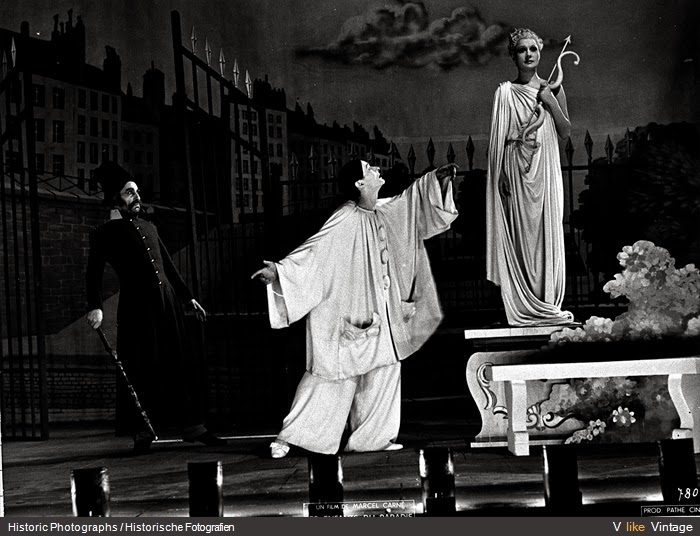
Baptiste (Jean-Louis Barrault) gives Garance (Arletty) a role in his latest pantomime 


(Color) 
Henry V. Art Direction: Paul Sheriff, Carmen Dillon.

Carmen Dillon
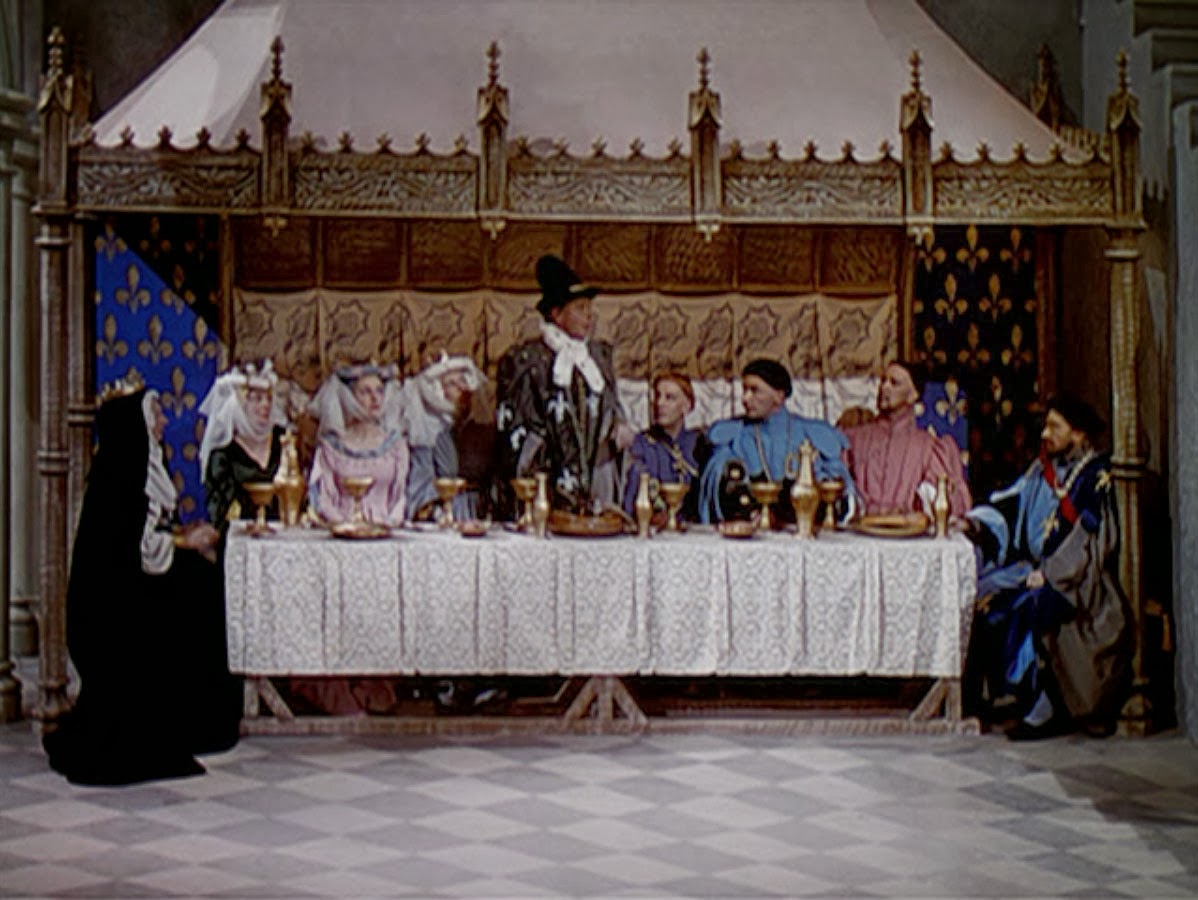
This fine version of Shakespeare's play was originally planned as a wartime morale booster, and it shows director and star Laurence Olivier at his creative best, well-supported by Leo Genn, Felix Aylmer, Robert Newton, Max Adrian, Robert Helpmann, Ernest Thesiger, and Renee Asherson, among many others. But it's also a tribute to the creative work of Paul Sheriff, the Russian-born designer who was the mainstay of many of the British-made films of the 1940s and '50s, and Carmen Dillon, who won an Oscar for Olivier's Hamlet. She also trained many of the British designers who would follow her in the 1960s and '70s, including Oscar winners John Box, Terence Marsh, and Roy Walker. The design of Henry V is something of a tour de force, as the film begins in a re-creation of the Elizabethan Globe theater, then moves into a stylized presentation, and finally into realistic battle scenes. Some of the sets are modeled on the images from the French gothic illuminated manuscript, the Très Riches Heures du Duc de Berry, which was contemporary with the actual King Henry V. 
From the Très Riches Heures du Duc de Berry
Banquet scene in Henry V 
The Chorus (Leslie Banks) on the stage of the Globe in Henry V
A view from the Globe stage in Henry V 
The stylized gates of Harfleur in Henry V
Laurence Olivier as Henry V