Showing posts with label Best Supporting Actress. Show all posts

Best Supporting Actress, 1949

Awards presented March 23, 1950
The nominees were ... 
... when they should have been ... 

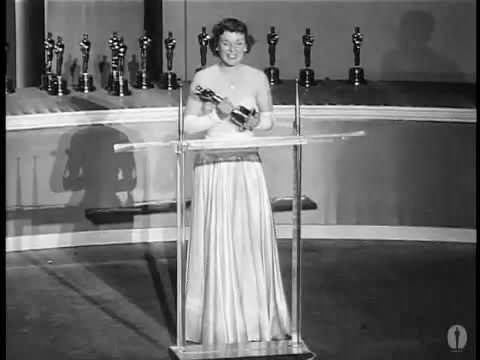
McCambridge accepts her Oscar
McCambridge began her acting career on radio in 1938, and made several appearances on Broadway before her screen debut as Willie Stark's campaign girl Friday in All the King's Men. The Oscar gave her no great career boost, however, and a few roles in minor films and on television followed. Her most memorable role during these years was as the over-the-top villain in Johnny Guitar (1954), Nicholas Ray's eccentric Western starring Joan Crawford; the movie was a flop, but has since, in large part thanks to McCambridge and Crawford, become a cult classic. She received a second Oscar nomination for her role in Giant, but much of her later career was spent in television guest appearances, with frequent appearances on Westerns like Rawhide, Bonanza and Gunsmoke. She returned to Broadway in 1962 to play Martha in Who's Afraid of Virginia Woolf?, replacing Uta Hagen. Her most famous role, however, was unseen: She initially received no billing for her work as the voice of the demon in The Exorcist, but sued Warner Bros. to obtain the screen credit.   
McCambridge, John Ireland, and Broderick Crawford in All the King's Men 

Best Supporting Actress, 1948

Awards presented March 24, 1949

And the nominees were ... 

... when they should have been ... 
And the Oscar went to ...

Trevor plays the alcoholic mistress of a gangster (Edward G. Robinson) in Key Largo, which was typical of her lot in films. Her first Oscar nomination was for the syphilitic prostitute in Dead End, and she played the whore cast out by the respectable townswomen in Stagecoach. After starting her acting career on Broadway, she came to Hollywood in 1933, toiling steadily in B-pictures before her breakthrough in Dead End and Stagecoach. Even the Oscar failed to propel her to major stardom, however, and after a third nomination in 1954 for The High and the Mighty, she did a mixture of television and smaller film roles. 

... when it should have gone to ... 

Marlene Dietrich in A Foreign Affair
Billy Wilder certified his reputation for cynicism by setting a romantic comedy in the ruins of Berlin. Jean Arthur plays a starchy congresswoman who comes to the ruined city on a fact-finding tour and falls in love with an officer (John Lund) whose mistress (Dietrich) is a cabaret singer and former Nazi. Taking the role was a daring move for Dietrich, who had become an American citizen in 1939 and spent the war in grueling tours entertaining the U.S. troops, which earned her the Medal of Freedom, the highest civilian honor. It also earned her the animosity of some of her fellow Germans. When she returned to Germany in 1960 for a concert tour, she was met with protests in the press and the streets, but the support of the popular West Berlin Mayor Willy Brandt helped smooth things over. 
Dietrich and Jean Arthur in A Foreign Affair

Best Supporting Actress, 1947

Awards presented March 20, 1948

The nominees were ... 

... when they should have been ... 

Always a welcome presence in movies, Holm had become a Broadway star in 1943 as Ado Annie in the original production of Oklahoma! She signed a contract with 20th Century-Fox and made her film debut in Three Little Girls in Blue in 1946. Her Oscar-winning role was characteristic of the parts that constituted most of her film career: the sensible, sophisticated woman, often the second lead as the star's confidante, as in All About Eve, which won her the third of her Oscar nominations. 

... when it should have gone to ... 

Martha Raye
Raye plays the vulgar Annabella Bonheur, one of a series of wealthy but unpleasant women whom Verdoux (Charles Chaplin) marries and murders -- although unlike the others, she proves remarkably and hilariously resistant to his attempts to bump her off. Today, unfortunately, Raye is mostly remembered for the denture-cleaner commercials she made in the 1980s, but she was a gifted comedian and a remarkably fine singer. The daughter of vaudevillians, she was on stage by the age of three and spent most of her childhood there, receiving little formal education. By the time she was in her teens, she was a featured vocalist with big bands, and she made her movie debut in 1934 as a nightclub singer in a short subject. Paramount signed her to a contract in 1936 when she appeared with Bing Crosby in Rhythm on the Range. The same year, she became a regular on Al Jolson's radio show, which gave her an opportunity to show off her singing ability, but her gift for clowning and her easily caricatured large mouth limited her screen appearances to comic roles. During World War II she began performing regularly with the USO in shows for the troops, a practice she continued during the Korean and Vietnam wars. This led to the Academy's awarding her the Jean Hersholt Humanitarian Award in 1969 and to the presentation of the Presidential Medal of Freedom by Bill Clinton in 1993, a year before her death. 
Raye and Charles Chaplin in Monsieur Verdoux

Supporting Actress, 1946

Awards presented March 13, 1947
The nominees were ... 

The granddaughter of Frank Lloyd Wright, Baxter began acting as a child, studied with Maria Ouspenskaya, appeared on Broadway in her teens, and made her film debut in 1940, when she was seventeen. Her first important role was as the ingenue in The Magnificent Ambersons. In her memoir, Intermission, Baxter recalled that illness forced her from the production of The Razor's Edge for a while, and when she returned she found that the cast had grown so close that she felt like an outsider -- which she used to heighten her character as the self-destructive Sophie, who descends into prostitution. After her most memorable film role, in All About Eve, she found herself typecast as the conniving bitch, most extravagantly as the campily seductive Egyptian princess in Cecil B. DeMille's The Ten Commandments. She went into semiretirement in the 1960s, when she married and moved to a cattle ranch in Australia. When she returned, she did most of her work on TV and on stage, where in 1971 she succeeded Lauren Bacall in the musical Applause, based on All About Eve, this time playing Margo Channing, the Bette Davis role.  

... when it should have gone to ... 

Humphrey Bogart and Martha Vickers in The Big Sleep
Would Martha Vickers have become a star if she had found more directors of the caliber of Howard Hawks? She almost steals the show as Lauren Bacall's naughty, nutty, thumb-sucking little sister in The Big Sleep. But except for this one film (and the fact that she was Mickey Rooney's third wife) she's almost completely forgotten. She began her career under her real name, Martha MacVicar, and was signed to a contract by David O. Selznick. But Selznick had a bad habit of signing actors and then forgetting about them -- unless they were Jennifer Jones -- and he let her go to Universal, which put her in a few horror movies and not much else. She moved to RKO and Warners and had some exposure as a pin-up girl during World War II, but it was not until Hawks cast her in The Big Sleep that she generated much interest as a movie actress. Even then, the part led to typecasting as a bad girl, and her career tapered off into forgotten movies and TV shows. She died young, from cancer, at the age of forty-six. 

Best Supporting Actress, 1945

Awards presented March 7, 1946
The nominees were ...  ... when they should have been ... 

Anne Revere and her Oscar
Velvet Brown (an unnervingly beautiful twelve-year-old Elizabeth Taylor) wins a horse in a raffle and, with the aid of scruffy Mi Taylor (Mickey Rooney), trains it to run in the Grand National steeplechase. When a jockey can't be found, she disguises herself as a boy and rides the horse herself. A classic, directed by Clarence Brown, that created a generation of horse-mad little girls. Revere's performance as Velvet's mother, who was a champion swimmer and wants her daughter to have the same chance to prove herself, is one of the film's highlights. Revere made her Broadway debut in 1931, but except for one film in 1934, didn't come to Hollywood until 1940. Though she sometimes played villains, she found her niche as a character actress in motherly roles: In addition to Taylor's in National Velvet, she played Jennifer Jones's in The Song of Bernadette and Gregory Peck's in Gentlemen's Agreement, receiving Oscar nominations for those roles. She also played John Garfield's mother in Body and Soul and Montgomery Clift's in A Place in the Sun, but wound up on the blacklist in 1951, the year of the latter picture's release, after invoking the Fifth Amendment in testimony before the House Un-American Activities Committee. (Lovers of irony always cite the fact that she was a direct descendant of Paul Revere.) She supported herself by giving acting lessons before resuming her career on Broadway, where she won the Tony Award for her performance in Toys in the Attic in 1960. She returned to the movies in 1970 for roles in Tell Me That You Love Me, Junie Moon and Macho Callahan, but much of her later career was spent on stage and television.  
Elizabeth Taylor and Revere in National Velvet 
 

Best Supporting Actress, 1944

Awards presented March 15, 1945
The nominees were ...

... when they should have been ... 

Barrymore was not the first choice for the role of Cary Grant's mother: Grant wanted Laurette Taylor, but her alcoholism took her out of the running. Of the three Barrymores, Ethel was the most reluctant film star. Lionel much preferred movies to the stage and made more than two hundred films. John oscillated between film and stage until his drinking made remembering lines and showing up every night too difficult. Ethel made a handful of silent films, but found the gratification of live audiences preferable, and had consented to make only one talkie, Rasputin and the Empress, with her brothers. Returning to the screen for None but the Lonely Heart at the age of sixty-five, she found the work much easier than the stage, and the good reviews and generous pay led her to make a score of movies before her death in 1959.  

... when it should have gone to ... 

Tallulah Bankhead
Bankhead got top billing in Lifeboat, but the film is an ensemble piece in which all the characters are literally in the same boat, so a supporting nomination would seem appropriate. Moreover, none of her previous films had amounted to much, so she was hardly in a position to demand recognition as a leading lady. She had made a few silents, and her distinctive husky voice led to her casting in several films in 1931 and 1932, but reviews were generally unfavorable so she returned to the stage. She scored her greatest theatrical triumph in 1939 as Regina in The Little Foxes, but the part went to Bette Davis when the play was filmed. She followed with another stage triumph in Thornton Wilder's The Skin of Our Teeth, in which her role, as Sabina, allowed her to break the fourth wall and talk directly to the audience. It was a foreshadowing of Bankhead's greatest success as a performer, as a TV talk show guest. Her part as the cynical journalist who boards the lifeboat in a mink coat after their ship is torpedoed suited her to a T. It didn't revive her film career, however. After one more film, the flop A Royal Scandal, she gave up movies altogether. Lifeboat did provide one choice addition to the many anecdotes about her lack of inhibitions: A complaint was lodged with the studio because a visitor to the set, which was the huge 20th Century-Fox water tank, had seen Bankhead hike up her skirts to climb into the lifeboat, thereby revealing that she wore no underwear. Director Alfred Hitchcock, asked to discuss the incident with Bankhead, declined, saying it was unclear who should take responsibility for the matter: wardrobe, makeup, or hairdressing.
Hume Cronyn, Henry Hull, Bankhead, John Hodiak, Mary Anderson, Canada Lee in Lifeboat

Best Supporting Actress, 1943

Awards presented March 2, 1944
The nominees were ... 
... when they should have been ... 

Paxinou as Pilar in For Whom the Bell Tolls
Trained as an opera singer, Paxinou became a celebrated stage actress in Greece, where she was one of the founders of the National Theatre. She starred in her own translation of Eugene O'Neill's Desire Under the Elms, and was acclaimed for her work in Chekhov and Strindberg. She was performing in London when war broke out, and was unable to return home, so she came to the United States, where she had previously appeared on stage. Her performance as Pilar, the leader of the guerrilla cadre, was her screen debut. Her performance is one of the highlights of an otherwise unsatisfying adaptation of Ernest Hemingway's novel, its story weakened and sapped of its flavor by the censors. Paxinou made only a few movies after For Whom the Bell Tolls, notably Mourning Becomes Electra, Orson Welles's Mr. Arkadin, and Luchino Visconti's Rocco and His Brothers. She returned to Greece after the war, but made occasional stage and television appearances in Britain and America.


Best Supporting Actress, 1942

Awards presented March 4, 1943

The nominees were ... 

... when they should have been ... 
And the Oscar went to ... 

Wright was discovered by Samuel Goldwyn in the cast of Life With Father on Broadway and signed to make her screen debut in The Little Foxes, for which she received her first nomination. A year later she became only the second person to receive simultaneous nominations in both leading and supporting role categories; she was also nominated for her role in The Pride of the Yankees. But aside from Shadow of a Doubt and The Best Years of Our Lives, her subsequent films were mostly undistinguished. As she began to outgrow ingenue roles, she spent most of her later career in television. 

... when it should have gone to ... 

Always cast in somewhat vinegary roles, such as the spinster Aunt Fanny in Ambersons, Moorehead had begun her career on radio as a singer and actress. This led to her association with Orson Welles as a member of his Mercury Theater Company, including the notorious "War of the Worlds" broadcast in 1938. She came with Welles to Hollywood to play the small role of Kane's mother in Citizen Kane, and signed a contract with RKO.  She received three more Oscar nominations, but never won. In later years, she frequently appeared on television, most memorably as Endora, the mother of Elizabeth Montgomery's character, Samantha, on "Bewitched." Moorehead hated being identified with the role. 

Agnes Moorehead as Fanny Minafer in The Magnificent Ambersons

Best Supporting Actress, 1941

Awards presented February 26, 1942

The nominees were ... 

... when they should have been ... 

Bette Davis loves George Brent, but Astor marries him. Then their marriage is annulled because Astor's divorce wasn't final, so Davis marries him after all. Then Brent is reported dead in a plane crash, and Astor turns out to be carrying his child, so Davis agrees to raise the baby as her own so that Astor can devote herself to her career as a concert pianist. But is Brent really dead? What do you think? Astor called it a potboiler, but she and Davis give it everything they've got, and that's considerable. Astor even claimed that she and Davis rewrote Lenore Coffee's screenplay and took the directing out of the hands of Edmund Goulding. If so, they made it a hell of a lot of fun, but as Astor herself said, she got the Oscar for the wrong picture....

... when it should have gone to ... 

Mary Astor as Brigid O'Shaughnessy and Humphrey Bogart as Sam Spade in The Maltese Falcon
Astor made one of her strongest screen impressions in a part that, interestingly, had previously been played by Davis in the vastly inferior 1936 version of The Maltese Falcon called Satan Met a Lady. Astor claimed that she hyperventilated before each scene in The Maltese Falcon to give her Brigid O'Shaughnessy that eerie instability. The Oscar was no doubt in recognition for her work in both The Great Lie and The Maltese Falcon, but also for a screen career that had begun in 1920, when she was fourteen. She was pushed into movies by her ambitious parents, who entered her in the beauty contests that caught Hollywood's eye. The stress brought about by her pushy parents -- who would later lose much of the money she earned in bad investments -- and her early success would catch up with her. In 1930 she suffered a mental breakdown brought on by the death of her first husband, and in 1932 she married the doctor, Franklyn Thorpe, who had tended her during her illness. They had a daughter, but the marriage was troubled, and in 1933 she had an affair with playwright George S. Kaufman. When Thorpe divorced her and sued for custody of their child, Astor became the center of a scandal in which Thorpe produced as evidence her diary, which detailed her affairs with Kaufman and others. The diary was ruled inadmissible -- Astor claimed that it had been stolen from her desk and that parts of it had been forged. The scandal threatened to end her career, but Samuel Goldwyn, who was about to release Dodsworth, featuring one of her best performances, stood by her, and the controversy faded. After the Oscar, she signed a contract with MGM, which cast her in sweetly maternal roles in such glossy films as Meet Me in St. Louis and the remake of Little Women, when she would have preferred grittier, bitchier parts. Her unhappiness at this turn in her career led to heavy drinking and an apparent suicide attempt from an overdose of sleeping pills, but she recovered with the help of Alcoholics Anonymous, and continued her career in films and on television. She made her last film, Hush ... Hush, Sweet Charlotte, in 1964, then spent twenty-three years in retirement.


Best Supporting Actress, 1940

Awards presented February 27, 1941

The nominees were ... 

... when they should have been ... 

Ma Joad was a plum role, and every character actress of a certain age, such as Beulah Bondi, campaigned for it. Darwell was a veteran who had made her first movies in 1913 and made her last screen appearance as the "Feed the Birds" woman in Mary Poppins -- a career that spanned fifty years. Walt Disney himself asked her to come out of retirement for her final role. 

... when it should have gone to ... 

Liz Embrie is one of those "gal pal" roles that cry out for the likes of Eve Arden or Celeste Holm -- who actually played the role in High Society, the musical remake of The Philadelphia Story. (Today the part would be written for a "gay best friend" and be played by Sean Hayes or Andrew Rannels.) But Hussey plays it to perfection, not only the wisecracks but also the wistful realization that James Stewart is smitten with Katharine Hepburn and not with her. It is, sadly, the only major movie role that Hussey ever landed after her film debut in 1937, when MGM, having spotted her in a touring company of Dead End, signed her to a contract. With a few exceptions -- she played Jordan Baker in the 1949 film version of The Great Gatsby and Bob Hope's wife in The Facts of Life -- she spent most of her movie career in B pictures, then did stage and television work before retiring in 1973. 

Ruth Hussey and James Stewart in The Philadelphia Story 

Best Supporting Actress, 1939

Awards presented February 29, 1940


The nominees were ... 

Hattie McDaniel with the plaque that supporting players were given instead of statuettes. Shortly before her death in 1952, it was presented to Howard University in Washington, D.C., but it has disappeared. 
Whatever one may say about the racial attitudes embodied in the character of Mammy, the role provided McDaniel with acting opportunities and screen time rarely granted to black performers of the era. Born in Kansas, she had to be trained in the dialect needed for the part. She began her career as a singer, a talent she rarely had a chance to use on screen, except in the 1936 Show Boat. Otherwise, both before and after Gone With the Wind, she was stuck playing maids, often, as in Alice Adams, making even those stereotypical parts memorable. She was the first black performer to be nominated for an Oscar, and for more than half a century, until Whoopi Goldberg won for Ghost, the only black woman to win an Academy Award for acting. On the other hand, McDaniel was not allowed to attend the premiere of GWTW in Atlanta, and her photograph did not appear in the souvenir program.

Clark Gable and Hattie McDaniel in Gone With the Wind 

Best Supporting Actress, 1938

Awards presented February 23, 1939

The nominees were ... 

... when they should have been ... 

Bainter, who was also nominated as best actress for White Banners, became the first person to receive simultaneous nominations in both acting categories. A theater veteran who made her Broadway debut in 1912, she didn't succumb to the lure of Hollywood until 1934. A reliable character actress throughout the 1940s, she made her last screen appearance in The Children's Hour in 1961, seven years before her death, and received another nomination. In Jezebel, Bainter has the somewhat thankless role of Aunt Belle, who tries to talk some sense into Julie, played by Bette Davis, after her headstrong niece disgraces herself by wearing a red dress to a ball to which all the women are expected to wear white.  
Bette Davis and Fay Bainter in Jezebel 

Best Supporting Actress, 1937

Awards presented March 10, 1938

The nominees were ... 

... when they should have been ... 
Until the 1943 awards, supporting players
received plaques instead of statuettes
Brady was born in a trunk, so to speak, the daughter of Broadway producer William A. Brady. She became a stage star while still very young, singing in operettas and acting in dramas. The movie producers in New York, which was then the center of filmmaking, discovered her, and she made her first movie in 1914, when she was twenty-two. After making scores of silent films, she returned to the stage in 1923, but the advent of sound brought her to Hollywood ten years later. She was as adept at comedy as at drama, and is probably better remembered as Ginger Rogers's Aunt Hortense in The Gay Divorcee, as Gloria Stuart's meddling mother in Gold Diggers of 1935, and as Carole Lombard's scatterbrained mother in My Man Godfrey, than she is as Mrs. O'Leary, whose careless cow starts the great Chicago fire of 1871 in In Old Chicago.
Tyrone Power, Alice Brady, and Don Ameche in In Old Chicago