Showing posts with label 1936. Show all posts

Best Actress, 1937

Awards presented March 10, 1938

The nominees were ... 

... when they should have been ... 
And the Oscar went to ... 
The role of O-lan in the screen adaptation of Pearl S. Buck's novel was Oscar bait, given that it's two hours and eighteen minutes of suffering and struggling. It made Rainer the first person to win two consecutive Oscars for acting and, until Jodie Foster's wins for The Accused and The Silence of the Lambs, the only person to win two Oscars while still under the age of thirty. Unfortunately, Rainer's triumph was short-lived. MGM had trouble finding suitable roles for her, and when her marriage to playwright-screenwriter Clifford Odets hit the skids, she retired from films except for a few scattered performances over the years.    

... when it should have gone to ... 
It is, quite simply, one of the movies' definitive performances. Though you can't always see what Garbo's Marguerite Gautier sees in Armand Duval, as played by the pretty, wooden Robert Taylor, you're always convinced that she's a woman in love. And the death scene is shattering: somehow Garbo lets you see the exact moment when life leaves Marguerite. It's not only shocking that Garbo should have lost to the rather ordinary performance of Rainer (we could have put up with her losing to another definitive performance: Barbara Stanwyck's Stella Dallas) but also that the film received no other nominations, despite skilled direction by George Cukor and luminous camerawork by William Daniels. The only explanation is that MGM was determined to promote the far more expensive The Good Earth, which was seen as a memorial to its producer, Irving Thalberg, who had died in 1936 before its completion. 


Director George Cukor (standing, left) films Greta Garbo and Robert Taylor in Camille

Honorary Awards, 1936

Awards presented March 4, 1937

To The March of Time for its significance to motion pictures and for having revolutionized one of the most important branches of the industry -- the newsreel.
To W. Howard Greene and Harold Rosson for the color cinematography of the Selznick International Production, The Garden of Allah.

Marlene Dietrich in The Garden of Allah
Charles Boyer and Dietrich
Dietrich and Basil Rathbone

The color in The Garden of Allah is undeniably breathtaking, and it emboldened David O. Selznick to shoot Gone With the Wind in Technicolor, in which Selznick's backer, multimillionaire Jock Whitney, owned stock. Unfortunately, the film itself is a tired piece of high camp from a novel by Robert Hitchens that had been filmed twice as a silent. Marlene Dietrich plays a rich woman sojourning in the desert, where she meets and marries Charles Boyer, who turns out to be a Trappist monk who fled the monastery and is drawn back to it by pangs of conscience. Both Boyer and Dietrich regretted making the movie. "It's twash, isn't it?" Dietrich asked dialogue director Joshua Logan, who had been brought in to tame the accents of the stars. The award to Greene and Rosson was the first of a series of honorary awards to cinematographers making color films. Color had been around for years in one form or another: Greene was a pioneer who had used two-color Technicolor for a sequence in the 1925 Ben-Hur. The expense of converting to sound, and the rather limited palette of the two-color process, had deterred the studios from making color films. But when Technicolor developed its three-color process in the mid-1930s, a greater willingness to experiment with it began. Greene would win an Oscar for The Phantom of the Opera (1943) after the award became competitive. Rosson, a veteran with a career as cinematographer stretching back to 1915, never won a competitive Oscar, though he was nominated five times. Only one of his nominations, for The Wizard of Oz, was for a color film. 

Best Dance Direction, 1936

Awards presented March 4, 1937

The nominees were ... 

... when they should have been ... 
And the Oscar went to ... 
Seymour Felix, "A Pretty Girl Is Like a Melody" number from The Great Ziegfeld. 
Felix began his career as a dancer in vaudeville, then moved into choreography on Broadway. He was lured to Hollywood in 1929 at the dawn of movie musicals. Although there is some dancing in the spectacular number for which he won the Oscar, it's mostly a triumph of sets and costumes, as Dennis Morgan (billed under his real name, Stanley Morner, and dubbed by Allan Jones) ascends a great staircase, spiraling around a column, while singing Irving Berlin's song to a bevy of chorus girls. 

... when it should have gone to ... 
Hermes Pan, "Let's Face the Music and Dance" number from Follow the Fleet. 
Nothing against the "Bojangles of Harlem" number, or the other great number from Swing Time, "Never Gonna Dance," but "Let's Face the Music and Dance" seems to me the pinnacle of the collaboration of Astaire, Rogers, and Pan. It uses Irving Berlin's song as the basis of a dance narrative about the meeting of two down-on-their-luck gamblers, Astaire and Rogers, who find consolation in each other. Rogers wears a rather amazing gown with a weighted hem that swirls around her as she moves and whose fit and translucency shows off her extraordinary figure. The number ends with a breathtaking strut as the two exit. 


Best Assistant Director, 1936

Awards presented March 4, 1937

The nominees were ... 
And the Oscar went to ... 


It was a logical choice for an assistant director win, with its sequences depicting the campaigns of the Light Brigade and the final, fatal charge. Sullivan was the assistant director, with two second assistant directors, Frank Heath and Fred Tyler, and a second unit director, B. Reeves Eason (who also directed the short Give Me Liberty that won the 1936 Oscar for a short film in color). It was Eason who came in for the most criticism when the trip wires used to make the charging horses fall resulted in the deaths of many horses. The film's star, Errol Flynn, protested the deaths, but director Michael Curtiz reportedly shrugged off the complaint. Eventually, however, the uproar over the deaths of the horses led to a new industry standard for the treatment of animals, including a ban on trip wires. Although the controversy seemed to have no effect on the film's Oscar chances, Warners kept The Charge of the Light Brigade out of circulation for many years. This is also the film, incidentally, on which the Hungarian-born Curtiz is said to have issued the command "Bring on the empty horses" -- meaning riderless ones -- that David Niven used as the title of one of his books.  

Best Short Films, 1936

Awards presented March 4, 1937

The changes in the short film categories reveal several things about what's going on in the film industry. The obvious one is the arrival of color as a major filmmaking tool. In a few years, the Academy would yield to the pressure to divide the cinematography and art direction (and eventually costuming) categories into black-and-white and color, a division that would last until color became so ubiquitous that black-and-white would be used only for artistic reasons, as in Raging Bull, Schindler's List, and The Artist. A live action color film, La Cucaracha, had already won the award for short film "Novelty" in 1934, and cartoons were almost always in color. The other is that the division of short films into "Comedy" and "Novelty" categories seemed somehow arbitrary. All of the "Novelties" so far had been documentary shorts, but there was no category for documentaries yet, and makers of short musical and dramatic films protested at being put into competition with them. The result was to create categories for "one-reel" (about eleven minutes) and "two-reel" (about twenty to twenty-four minutes) shorts. Two-reelers would begin to fall out of favor once the double feature became popular.     

The nominees were ... 

(Cartoon) 
(Color) 
(One-reel) 
(Two-reel) 
And the Oscar went to ... 
(Cartoon) 
The Country Cousin, Walt Disney, producer.
Abner the Mouse visits his cousin Morty in the big city.


(Color)
Give Me Liberty, Warner Bros.
A two-reel short, centered on Patrick Henry's 1775 speech before the Virginia House of Burgesses. The film invents some tension between Henry (John Litel) and his wife (Nedda Harrigan) over whether he will speak. Directed by B. Reeves (Breezy) Eason, a well-known second-unit director who also filmed the burning of Atlanta in Gone With the Wind.


(One-reel)
Bored of Education, Hal Roach, producer.
The Our Gang kids contrive a way to get out of going to school.


(Two-reel)
The Public Pays, Metro-Goldwyn-Mayer.
No. 8 in the Crime Does Not Pay series, a drama about a protection racket aimed at milk producers.  

Best Film Editing, 1936

Awards presented March 4, 1937

The nominees were ... 

... when they should have been ... 
And the Oscar went to ... 
Dawson had won an Oscar for film editing the previous year. He'll win another two years later, for The Adventures of Robin Hood.  

... when it should have gone to ... 
Held would normally get the nod from the Academy because he is the nominal film editor on San Francisco, and he would be nominated for two Oscars in 1939. Perhaps he missed out on this one, because the earthquake sequence, which is the editing tour de force in the film, was done by John Hoffman and especially Slavko Vorkapich, whose work with montage is ranked alongside that of Sergei Eisenstein in influence. See here for some visual evidence of Vorkapich's work on San Francisco. 
Slavko Vorkapich, seated, demonstrates the classic editing device, the Moviola, c. 1950.

Best Music, 1936

Awards presented March 4, 1937

The nominees were ... 

(Scoring) 
(Song) 
... when they should have been ... 
(Song) 
And the Oscar went to ... 
(Scoring) 
Anthony Adverse, Warner Bros. Studio Music Department, Leo Forbstein, head of department (Score by Erich Wolfgang Korngold). 
Forbstein got the Oscar, but Korngold won it for him. 


(Song)
"The Way You Look Tonight" from Swing Time, Music by Jerome Kern; Lyrics by Dorothy Fields.
Kern, one of the greatest of American songwriters, won two Oscars -- the other was for "The Last Time I Saw Paris" from Lady Be Good -- and was nominated six more times. This was Fields's second nomination and her only win.
Jerome Kern, Dorothy Fields, and George Gershwin

Best Sound, 1936

Awards presented March 4, 1937

The nominees were ... 

And the Oscar went to ... 
San Francisco, Metro-Goldwyn-Mayer Studio Sound Department, Douglas Shearer, Sound Director. 
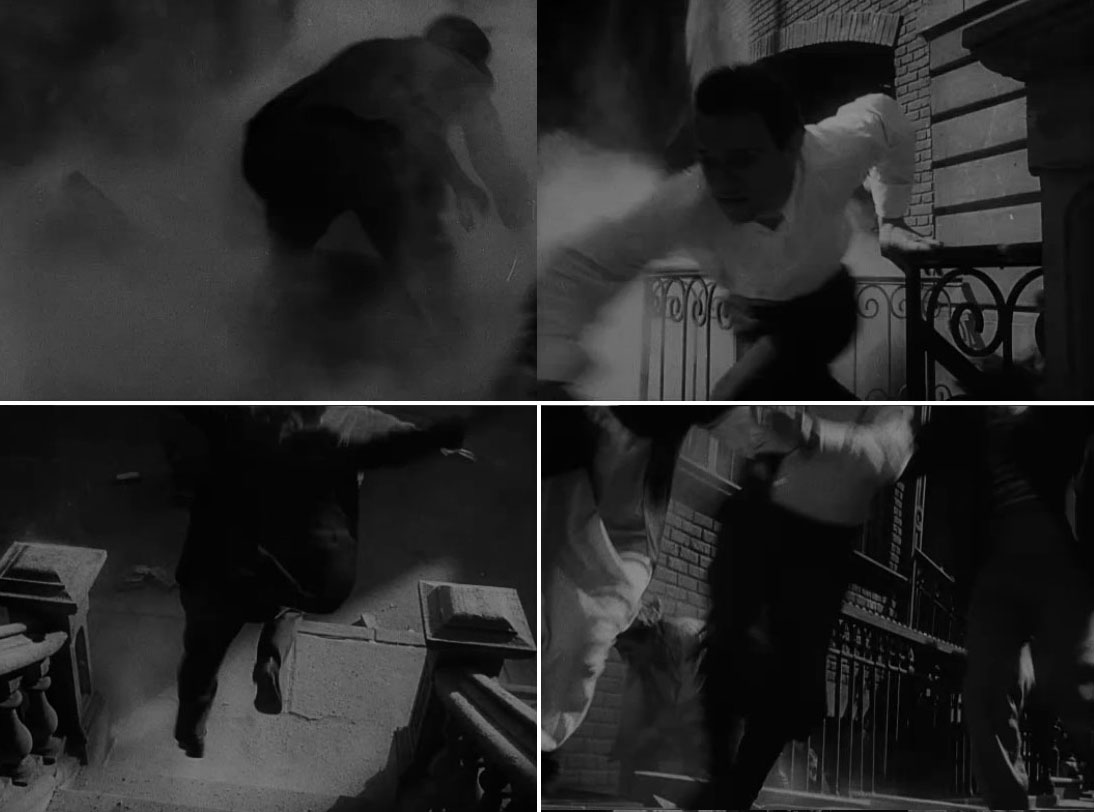
Shearer's unfortunately anonymous sound crew deserved the award, not just for recording Jeanette MacDonald, but mainly for the sound effects supplied for the earthquake sequence, which is probably the only reason anyone watches the film today. 
Jeanette MacDonald auditions for Clark Gable in San Francisco
The aftermath of the quake in San Francisco
 The visuals for the earthquake sequence were supervised by James Basevi and edited by Slavko Vorkapich. The special effects category had not yet been returned to the awards, so neither was nominated. A case could have been made for nominating Vorkapich for editing, however, but he wasn't included among the nominees.


Best Art Direction, 1936

Awards presented March 4, 1937

The nominees were ... 

And the Oscar went to ... 
Richard Day, Dodsworth. 

Richard Day
Day's Oscar was the only one Dodsworth received, which is a bit shocking -- not that Day didn't deserve it, because he did, but because the picture should have won more. He received twenty nominations and won seven times in a fifty-year career that stretched from work as a set decorator for the persnickety Erich von Stroheim in 1919 to the art direction of Tora! Tora! Tora! in 1970, two years before his death. Unlike the much-honored Cedric Gibbons at MGM, Day was not tied down to any one studio, so most of the work credited to him was in fact his own. He did much of his work for Samuel Goldwyn, a producer much obsessed with prestige.  


  Above: scenes from Dodsworth

Best Cinematography, 1936

Awards presented March 4, 1937

The nominees were ... 

... when they should have been ... 
Gaetano Gaudio, Anthony Adverse. 
Gaudio, usually billed as Tony Gaudio, and sometimes in the early years as Antonio, was a pioneering cameraman, making films as early as 1903 in his native Italy. He came to the United States in 1906 and became one of the most prolific cinematographers of the silent film era, shooting the early films of Mary Pickford and Douglas Fairbanks, among others. He spent most of his career at Warner Bros., and received five nominations in addition to the award for Anthony Adverse.  

... when it should have gone to ... 
Bert Glennon, The Prisoner of Shark Island. 
Bert Glennon
Glennon went into the movie business right out of Stanford, working as a camera operator starting in 1916. He was cinematographer on Cecil B. DeMille's 1924 version of The Ten Commandments, and shot several features with Josef von Sternberg. The Prisoner of Shark Island was the first of several collaborations with director John Ford, two of which, Stagecoach and Drums Along the Mohawk, earned him Oscar nominations. His work on The Prisoner of Shark Island shows his skill at lighting for atmosphere, both on closeups and on the shadow-haunted prison. In the sequence shown below, the death of Abraham Lincoln is filmed through a curtain; as Glennon gradually pulls the focus back, the curtain veils the dead president's face, an effect more dramatic than a standard fade-out. Shark Island is one of Ford's lesser-known films, no thanks to the Academy, which gave it no nominations, but its telling of the unjust imprisonment of Dr. Samuel Mudd (Warner Baxter), who set John Wilkes Booth's broken leg after the assassination, is well handled. Among other things, Baxter's performance almost justifies the Oscar he was rather prematurely given for In Old Arizona.  


Best Writing, 1936

Awards presented March 4, 1937

The nominees were ... 

(Original Story) 
(Screenplay) 
... when they should have been ... 
(Original Story)
(Screenplay) 

And the Oscar went to ... 
(Original Story)
(Screenplay)
Collings and Gibney were the only writers to take home two writing Oscars for the same film, and were the first to be nominated in both writing categories. Previously there had been no overlap between the films nominated in the two categories, story and screenplay, but as this happened more and more often, the Academy began to rethink the divisions in the writing categories. Over time, this evolved into the current writing categories, one for screenplay written originally for the movies and one for adaptations from other media. Collings, who had been a screenwriter since 1925, died of pneumonia in the same year that he received the Oscars. Gibney served two terms as president of the Screen Writers Guild in the 1940s.

... when it should have gone to ... 
(Original Story) 
Chaplin and Paulette Godard hit the road 
 Granted, René Clair's studio claimed that Chaplin ripped off À Nous la liberté for this particular "original story," but he claimed that his inspiration came from a conversation with Gandhi about the mechanization of modern life.  Modern Times was in fact an anomaly in the age of sound, though Chaplin originally planned it as a talkie, even writing dialogue for it before deciding that the humor in it should remain essentially visual. His voice is heard, however, in one scene in which he sings a song in gibberish. In any case, the Academy's neglect of the film, giving it no nominations in any category, was absurd.

(Screenplay) 
In 1937 Sidney Howard was well known enough to make the cover of Time. Today he is remembered mainly by Oscar buffs who know that he won the award posthumously (he died in a tractor accident on his Massachusetts farm) for the screenplay of Gone With the Wind, even though it had been worked over by every writer in Hollywood from Ben Hecht to F. Scott Fitzgerald. Musical theater fans also know that his Pulitzer Prize-winning play They Knew What They Wanted was adapted by Frank Loesser into The Most Happy Fella. Howard was brought to Hollywood by the prestige-seeking producer Sam Goldwyn, for whom he adapted the Sinclair Lewis novels Arrowsmith and Dodsworth for the movies, having already had a Broadway success with a stage adaptation of the latter. Howard's plays are seldom performed today, but his Dodsworth screenplay is in many ways an improvement on Lewis's novel, being tighter and less didactic. His daughter, Jennifer Howard, married Samuel Goldwyn Jr., making Sidney Howard the grandfather of the actor Tony Goldwyn.