Showing posts with label Edwin B. Willis. Show all posts

Best Art Direction, 1946

Awards presented March 13, 1947

Like the cinematographers, the art directors decided to sharply reduce the number of nominees this year -- in their case, to three per category. 


The nominees were ... 
(Black-and-White) 
(Color) 
... when they should have been ... 
(Black-and-White) 
(Color) 
And the Oscar went to ... 
(Black-and-White) 

The lavish decor for the movie sometimes resembles that of a very expensive Thai restaurant. Director John Cromwell had hoped for color, but the studio wouldn't spring for it. Art director Lyle Wheeler got his chance to do it over in color ten years later when it became The King and I, reusing many of the original designs. He won an Oscar for that version, too.  

(Color) 
The Yearling. Art Direction: Cedric Gibbons, Paul Groesse; Interior Decoration: Edwin B. Willis. 

Something of a surprise winner in this category, given that much of the film takes place out of doors and the interiors are the sparsely furnished cabins of impoverished Florida farmers. 

... when it should have gone to ... 
(Black-and-White) 
Alexandre Traunder

Léon Barsacq
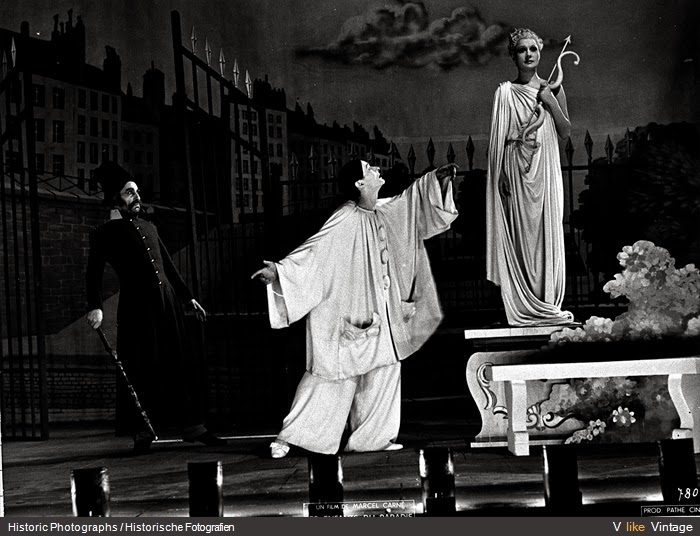
Marcel Carné's brilliant re-creation of the nineteenth-century French theater scene was made under the harshest of conditions under Nazi occupation, including the fact that art director Alexandre Trauner was Jewish, and was forced to hide that fact from the Vichy authorities. Some of the exterior sets had to be completely rebuilt after being damaged by a storm, and throughout the filming materials were in short supply. So the fact that the film was made at all is remarkable enough. That it is truly beautiful as well is miraculous. Barsacq would later be nominated for his work on The Longest Day. Trauner would have a regular working relationship with Billy Wilder and win an Oscar for The Apartment, as well as being nominated for his work with John Huston on The Man Who Would Be King.
Baptiste (Jean-Louis Barrault) gives Garance (Arletty) a role in his latest pantomime 


(Color) 
Henry V. Art Direction: Paul Sheriff, Carmen Dillon.

Carmen Dillon
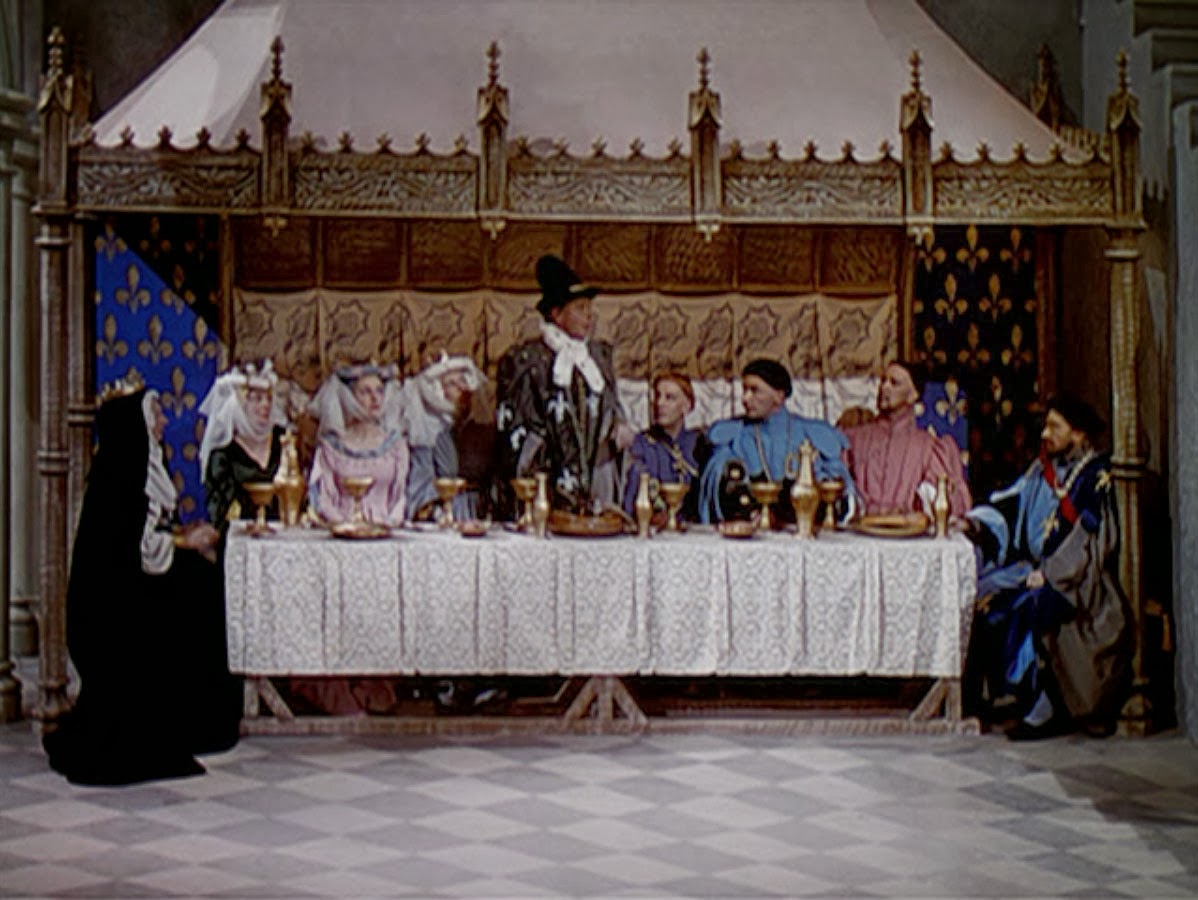
This fine version of Shakespeare's play was originally planned as a wartime morale booster, and it shows director and star Laurence Olivier at his creative best, well-supported by Leo Genn, Felix Aylmer, Robert Newton, Max Adrian, Robert Helpmann, Ernest Thesiger, and Renee Asherson, among many others. But it's also a tribute to the creative work of Paul Sheriff, the Russian-born designer who was the mainstay of many of the British-made films of the 1940s and '50s, and Carmen Dillon, who won an Oscar for Olivier's Hamlet. She also trained many of the British designers who would follow her in the 1960s and '70s, including Oscar winners John Box, Terence Marsh, and Roy Walker. The design of Henry V is something of a tour de force, as the film begins in a re-creation of the Elizabethan Globe theater, then moves into a stylized presentation, and finally into realistic battle scenes. Some of the sets are modeled on the images from the French gothic illuminated manuscript, the Très Riches Heures du Duc de Berry, which was contemporary with the actual King Henry V. 
From the Très Riches Heures du Duc de Berry
Banquet scene in Henry V 
The Chorus (Leslie Banks) on the stage of the Globe in Henry V
A view from the Globe stage in Henry V 
The stylized gates of Harfleur in Henry V
Laurence Olivier as Henry V 


Best Art Direction, 1944

Awards presented March 15, 1945
The nominees were ...
(Black-and-White) 

(Color) 
... when they should have been ... 
(Color) 
And the Oscar went to ... 
(Black-and-White) 
Gaslight. Art Direction: Cedric Gibbons, William Ferrari; Interior Decoration: Edwin B. Willis, Paul Huldschinsky. 

Ingrid Bergman, being gaslighted in Gaslight
A suave psychopath (Charles Boyer) tries to persuade his young wife (Ingrid Bergman) that she's going mad in this remake of a superior British film, released in 1940, which MGM tried to suppress when it released this version. The gloomy Victorian sets add much to the atmosphere of menace. Gibbons and Willis, as heads  of their respective departments, were routinely and frequently nominated, and much of the credit for the look of the film probably belongs to Ferrari and Huldschinsky. This was the sole Oscar for Ferrari, who would later be nominated for How the West Was Won. It was also the only Oscar for Huldschinsky, whose career at MGM was brief -- he died in 1947. It's interesting to compare his work on Gaslight to his work on Meet Me in St. Louis, released the same year. Both have Victorian/Edwardian settings, but where the ones in Gaslight are sinister and creepy, the ones in Meet Me in St. Louis radiate coziness and warmth.  

(Color)
Wilson. Art Direction: Wiard Ihnen; Interior Decoration: Thomas Little. 

This was the first of two consecutive Oscars for Ihnen, who had begun his career as an art director in 1919 at Famous Players-Lasky, the forerunner of Paramount. He was married to costume designer Edith Head. It was the fifth Oscar win for Little, who had won in four consecutive years. He would skip a year, and then win one more time. 

... when it should have gone to ... 
(Color) 

The art direction Oscar was still very much under the control of the studios for the 1944 awards, which meant that each studio could and did supply the nominees. Sometimes this got a bit absurd: Universal's nomination for color art direction was The Climax, which was not only something of a rip-off of the story line of The Phantom of the Opera -- a madman has a young soprano (played in both films by Susanna Foster) under his spell -- but also used the same sets that were used for that film, and which had won the 1943 art direction Oscar. But how to explain MGM's choice of nominee: Kismet, a kitschy treatment of an old warhorse of a play that seems more suitable for Universal's Jon Hall-Maria Montez series than for a glossy MGM treatment with Ronald Colman and Marlene Dietrich? The answer may be that the Kismet sets look an awful lot like a previous art direction winner, The Thief of Bagdad. But were they really better than the sumptuous sets for the Smith family home in Vincente Minnelli's Meet Me in St. Louis? No. It may also be that MGM (meaning art department head Cedric Gibbons) thought that nominating one movie with Victorian sets, Gaslight, was enough. As far as set decorator Paul Huldschinsky was concerned, it was: He won an Oscar -- his only one, and his only nomination -- for Gaslight. This was one of the first films on which designer Jack Martin Smith worked at MGM. He would go on to design sets for other musicals produced by the Freed unit, and would win three Oscars. 

The Smith home, winter
The Smith home, summer. The "St. Louis" house stood on the MGM lot until the late 1960s, when the studio's property, sets, costumes, everything, was sold. 
Above, Minnelli shows Judy Garland how to snuff the gaslight chandelier. Below, Tom Drake does the task in the film.

Mary Astor and Margaret O'Brien in Tootie's bedroom
Garland descends the stairs

Best Art Direction, 1943

Awards presented March 2, 1944
The nominees were ... 
(Black-and-White)
(Color)
... when they should have been ... 
(Black-and-White) 
And the Oscar went to ... 
(Black-and-White) 
The Song of Bernadette. Art Direction: James Basevi, William Darling; Interior Decoration: Thomas Little. 

This was the only Oscar for Basevi, who began his set design career in 1924 at MGM, then moved to United Artists before landing at 20th Century-Fox in 1941. He was loaned to David O. Selznick in 1945 for Spellbound, on which he translated Salvador Dalí's designs into sets for the dream sequences. This was the second of Darling's three Oscars. Born in Hungary, he adopted his wife's maiden name as a surname in the United States. He went to work for Fox in 1922, and remained with the company when it merged to become 20th Century-Fox. Little, head of the 20th Century-Fox set decorating department, received six Oscars. 

(Color) 


Claude Rains and Susanna Foster
While the 1943 Phantom is mostly a camp-fest, it's undeniably a gorgeously designed one. This was the only Oscar for Goodman out of four nominations; he began his career in 1932 at Paramount, and moved to Universal in 1940. Golitzen was the more famous name, earning fourteen nominations with three wins, of which this was the first. He worked at first primarily with the major independent producers, Samuel Goldwyn and Walter Wanger, but joined Universal, where he became the chief art director in 1954, a job that he held for the next twenty years. Gausman worked closely with Golitzen, winning both of his Oscars on films on which they collaborated. This was the sole Oscar for Webb, also a frequent collaborator with the other three men.  


Nelson Eddy in Phantom of the Opera 


... when it should have gone to ... 
(Black-and-White) 
Cabin in the Sky. Art Direction: Cedric Gibbons, Leonid Vasian; Interior Decoration: Edwin B. Willis, Hugh Hunt.

Little Joe (Eddie "Rochester" Anderson) is torn between his wife, Petunia (Ethel Waters), and the glamorous singer Georgia Brown (Lena Horne). When he's wounded in a nightclub fight a battle for his soul begins between Lucifer (Rex Ingram) and the General (Kenneth Spencer). He's saved by Petunia's devotion. The racial stereotypes in director Vincente Minnelli's first film are uncomfortable today, though MGM went out of its way to avoid the controversy that had been generated by its 1936 film of The Green Pastures, consulting with members of Hollywood's black community. Say what you will about the story and the characters, the performances are wonderful. In addition to the principals the cast includes Louis Armstrong, Duke Ellington, and the original Sportin' Life of Porgy and Bess, John Bubbles. The look of Cabin in the Sky is probably chiefly attributable to Minnelli, who began his career as a theatrical costume and set designer before becoming a stage director. He didn't have a hand in the original Broadway production, which was directed by Albert Lewis and staged by George Balanchine, but the sets for the film version are deliberately theatrical. As usual with MGM productions, Gibbons and Willis are nominated because they were department heads. Vasian, one of the studio's second-string designers, never received an Oscar nomination. Hunt, however, won for Julius Caesar and Ben-Hur, and was nominated eleven more times. 
The General sets Petunia and Joe off on the starway to heaven
Joe is tempted by Georgia Brown as the General and Lucifer look on
A screen test of the cabin set
Georgia's dressing room

Interior of the cabin 

The cabin's bedroom
     

Best Art Direction, 1941

Awards presented February 26, 1942

A new refinement on the award designated both an art director and a set decorator (at first called "interior decoration"), though the two have always been tandem nominations, i.e., both for the same film. Studios were allowed to submit one nomination for a black-and-white film and one for a color film; for some reason, Republic withdrew its nomination of a Judy Canova comedy called Sis Hopkins before the voting took place.

The nominees were ... 
(Black-and-White) 

(Color) 
 And the Oscar went to ... 
(Black-and-White) 
How Green Was My Valley, art direction, Richard Day, Nathan Juran; interior decoration, Thomas Little. 

Nathan Juran
To film the Welsh mining town of the Richard Llewellyn novel on which the movie was based, Day's design crew built one, or at least parts of it, in Malibu Creek State Park in California. This was the third of Day's seven Oscars and the first of Little's six. Both of them headed their respective departments, art direction and set decoration, at 20th Century-Fox. It was the only win for Juran, whose career was interrupted by service in World War II. He worked again with Day and Little, earning another nomination for The Razor's Edge, but in 1952 he moved from art direction to just plain directing, mostly of low-budget Westerns and sci-fi, including Attack of the 50 Foot Woman (which he directed under the pseudonym "Nathan Hertz"). In the 1960s he moved into television, directing episodes of "Lost in Space" and "Land of the Giants," among other series. 

Filming a scene for How Green Was My Valley on the set of the Welsh town built in a California state park


Maureen O'Hara in How Green Was My Valley
(Color) 
Blossoms in the Dust, art direction, Cedric Gibbons, Urie McCleary; interior decoration, Edwin B. Willis.

Greer Garson plays Edna Gladney, founder of an orphanage in Fort Worth, Texas, who has to battle snobs and prudes in her efforts to find homes for children born out of wedlock. It's a rather icky biopic, but it gets a high-gloss Technicolor treatment from MGM. As usual, Gibbons shares credit for what was mostly the work of McCleary, the associate art director. This was his first win out of his nominations, and he would win again for Patton thirty years later. It was the first of eight wins for Willis, the head of the set decorating department at MGM.
Greer Garson as Edna Gladney in Blossoms in the Dust

Gladney finds suitable parents for an orphan ... 

... but also has to put up with disapproving women.