Showing posts with label Best Art Direction. Show all posts

Best Art Direction, 1948

Awards presented March 24, 1949

And the nominees were ... 
(Black-and-White)

(Color) 
... when they should have been ... 
(Black-and-White) 
(Color) 
And the Oscar went to ... 
(Black-and-White) 
Hamlet. Art direction, Roger K. Furse; set decoration, Carmen Dillon. 

Furse had designed the costumes for Olivier's film of Henry V, but the costume Oscar had not been created yet. He was in luck this year: He also won the first ever black-and-white costume design award for Hamlet. Dillon had been nominated for the sets of Henry V, and would collaborate with Furse and Olivier again on Richard III.  

(Color) 
The Red Shoes. Art direction, Hein Heckroth; set decoration, Arthur Lawson.


Sketches by Hein Heckroth for The Red Shoes
Unlike the cinematographers, who denied Jack Cardiff a nomination and thus a second consecutive win by a Brit in their category, the art directors were not so jingoist, so this was the second Powell-Pressburger film in a row to take the color art direction Oscar. Heckroth had been a set designer for the ballet and theater in Germany, but left because his wife was Jewish. After living in the Netherlands and France, he ended up in England in 1935, where he designed for the opera before going to work for Alexander Korda on the film of Shaw's Caesar and Cleopatra. Unhappy with working for Korda, he was hired away by Alfred Junge, the design director for Powell and Pressburger, and designed the costumes for their A Matter of Life and Death and Black Narcissus. When Junge disagreed with them on the look for The Red Shoes, he quit and was replaced by Heckroth, who was nominated for both sets and costumes for The Tales of Hoffman before returning to Germany in the mid-1950s. This was the only nomination for Lawson, who was a prominent art director in Britain until his death in 1970. 
Moira Shearer and Léonide Massine in The Red Shoes
... when it should have gone to ... 
(Black-and-White) 
Beauty and the Beast. Art direction, Christian Bérard, Carré; set decoration, René Moulaert.


Christian Bérard
Jean Cocteau's La Belle et la bête had its premiere at the Cannes festival in 1946, but was not seen in the United States until December 1947, and didn't receive a release that would qualify it for the Oscars until 1948. The Academy ignored it, however, as it did many foreign contributions to cinematic art, though Christian Bérard's collaboration with Cocteau produced images that remain as haunting today as they were when they first appeared. There was no makeup Oscar at the time, so Hagop Arakelian's magnificent Beast had no place to be admired, although almost everyone agrees that he's a far handsomer being than the somewhat wimpy prince he's revealed to be at the end: As the familiar story has it, Greta Garbo cried out, "Give me back my Beast!" when he's transformed. (A similar reaction occurs to the Disney film, which clearly modeled its Beast on Cocteau's.) Lucien Carré, who was sometimes credited only with his surname, was a French production designer whose career spanned thirty years.

Sketches by Christian Bérard for Beauty and the Beast 
Belle's father (Marcel André) in the Beast's castle
Belle (Josette Day) in the Beast's castle
Day and Jean Marais

Belle and the Prince, released from the spell, are swept away to his kingdom


Best Art Direction, 1947

Awards presented March 20, 1948

The nominees were ... 
(Black-and-White) 

(Color) 
And the Oscar went to ... 
(Black-and-White) 
Great Expectations. Art direction: John Bryan; set decoration: Wilfred Shingleton.

Not only did the Brits win both art directing Oscars, but the same films won for both cinematography and art direction. Something was happening to the Hollywood studio factory system, and it wasn't good. This was the only win for Bryan, who had previously been nominated for Caesar and Cleopatra and would receive another nomination for Becket. He had worked as art director and production designer since 1934. His earlier credits include Pygmalion. He would turn producer in 1954, while still keeping his hand in on production designs. This was the sole win and nomination for Shingleton, who doubled as art director and production designer. His later credits include The African Queen, Voyage of the Damned, and the TV miniseries "Holocaust." 


Production designs by John Bryan, top and center, and the on-camera realization of Miss Havisham's home
(Color) 
Black Narcissus. Art direction and set decoration: Alfred Junge.  
Alfred Junge

Born in Germany, Junge began working in the theater as a teenager, and in 1920 joined the UFA studios in Berlin. In 1932 he repatriated to England, where he became head of the art department at Gaumont-British, and then, until the start of World War II, served as head of the art department of MGM's British film division, designing such films as The Citadel and Goodbye, Mr. Chips. In 1939 he began working with filmmakers Michael Powell and Emeric Pressburger, which led to his Oscar for Black Narcissus. He later worked again for MGM in Britain on such films as Ivanhoe, Mogambo, and Knights of the Round Table, receiving another nomination for the last-named. 
Black Narcissus
Notes made by Junge for Black Narcissus. Below, two sketches by Junge for the film, now in the collections of the University of Texas at Austin 


Best Art Direction, 1946

Awards presented March 13, 1947

Like the cinematographers, the art directors decided to sharply reduce the number of nominees this year -- in their case, to three per category. 


The nominees were ... 
(Black-and-White) 
(Color) 
... when they should have been ... 
(Black-and-White) 
(Color) 
And the Oscar went to ... 
(Black-and-White) 

The lavish decor for the movie sometimes resembles that of a very expensive Thai restaurant. Director John Cromwell had hoped for color, but the studio wouldn't spring for it. Art director Lyle Wheeler got his chance to do it over in color ten years later when it became The King and I, reusing many of the original designs. He won an Oscar for that version, too.  

(Color) 
The Yearling. Art Direction: Cedric Gibbons, Paul Groesse; Interior Decoration: Edwin B. Willis. 

Something of a surprise winner in this category, given that much of the film takes place out of doors and the interiors are the sparsely furnished cabins of impoverished Florida farmers. 

... when it should have gone to ... 
(Black-and-White) 
Alexandre Traunder

Léon Barsacq
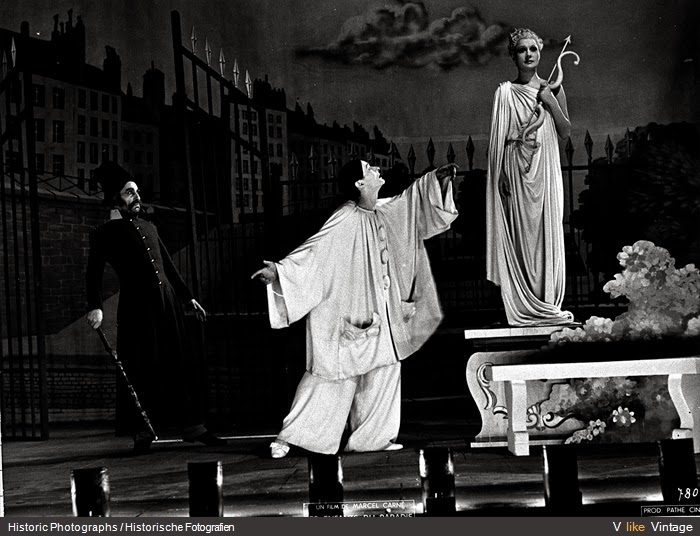
Marcel Carné's brilliant re-creation of the nineteenth-century French theater scene was made under the harshest of conditions under Nazi occupation, including the fact that art director Alexandre Trauner was Jewish, and was forced to hide that fact from the Vichy authorities. Some of the exterior sets had to be completely rebuilt after being damaged by a storm, and throughout the filming materials were in short supply. So the fact that the film was made at all is remarkable enough. That it is truly beautiful as well is miraculous. Barsacq would later be nominated for his work on The Longest Day. Trauner would have a regular working relationship with Billy Wilder and win an Oscar for The Apartment, as well as being nominated for his work with John Huston on The Man Who Would Be King.
Baptiste (Jean-Louis Barrault) gives Garance (Arletty) a role in his latest pantomime 


(Color) 
Henry V. Art Direction: Paul Sheriff, Carmen Dillon.

Carmen Dillon
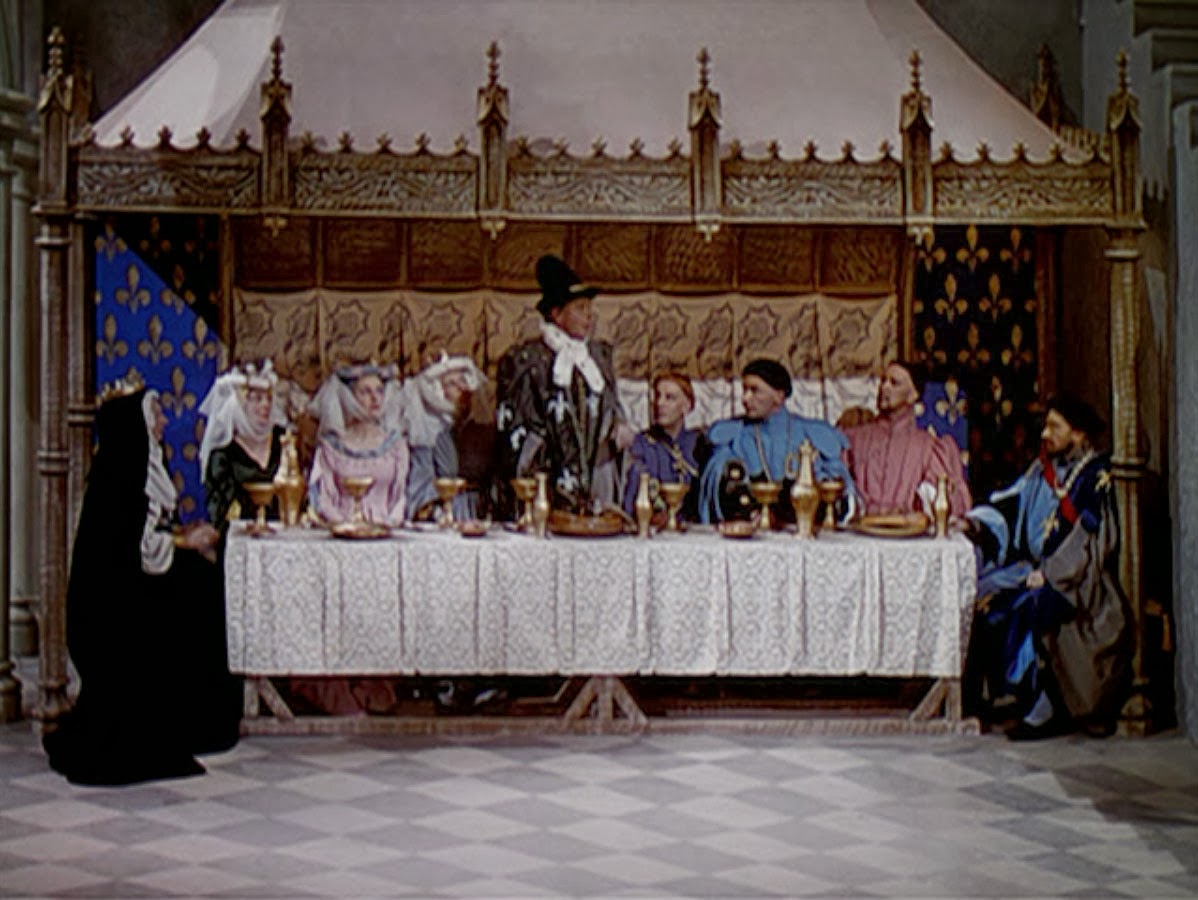
This fine version of Shakespeare's play was originally planned as a wartime morale booster, and it shows director and star Laurence Olivier at his creative best, well-supported by Leo Genn, Felix Aylmer, Robert Newton, Max Adrian, Robert Helpmann, Ernest Thesiger, and Renee Asherson, among many others. But it's also a tribute to the creative work of Paul Sheriff, the Russian-born designer who was the mainstay of many of the British-made films of the 1940s and '50s, and Carmen Dillon, who won an Oscar for Olivier's Hamlet. She also trained many of the British designers who would follow her in the 1960s and '70s, including Oscar winners John Box, Terence Marsh, and Roy Walker. The design of Henry V is something of a tour de force, as the film begins in a re-creation of the Elizabethan Globe theater, then moves into a stylized presentation, and finally into realistic battle scenes. Some of the sets are modeled on the images from the French gothic illuminated manuscript, the Très Riches Heures du Duc de Berry, which was contemporary with the actual King Henry V. 
From the Très Riches Heures du Duc de Berry
Banquet scene in Henry V 
The Chorus (Leslie Banks) on the stage of the Globe in Henry V
A view from the Globe stage in Henry V 
The stylized gates of Harfleur in Henry V
Laurence Olivier as Henry V 


Best Art Direction, 1945

Awards presented March 7, 1946
The nominees were ... 
(Black-and-White)
(Color) 
... when they should have been ... 
(Black-and-White) 
And the Oscar went to ... 
(Black-and-White) 
Blood on the Sun. Art Direction: Wiard Ihnen; Interior Decoration: A. Roland Fields. 

James Cagney plays a newspaper editor and Sylvia Sidney a Eurasian counterintelligence agent in pre-World War II Japan. Thick with propaganda, the movie still manages to be fairly entertaining today. Ihnen picked up his second Oscar in a row for the film, which was produced by Cagney and his brother William for their independent production company. This was the only Oscar win for Fields, who was nominated for his work on Citizen Kane and The Magnificent Ambersons, and should have won for both. 

(Color) 
Frenchman's Creek. Art Direction: Hans Dreier, Ernst Fegte; Interior Decoration: Sam Comer. 

Beautiful but empty-headed Restoration bodice-ripper in which Joan Fontaine enters into a loveless marriage to Ralph Forbes to escape the designs of his rakish friend Basil Rathbone. She escapes to her family home in Cornwall, where she meets handsome pirate Arturo de Cordova. This was the first Oscar win for Dreier, the head of the Paramount art department. He had been nominated eighteen times previously, and would be nominated three more times and win twice. This was the only win out of four nominations for Fegte. This was the first of four wins for Comer, Paramount's head set decorator. He was nominated twenty-six times. 

... when it should have gone to ... 
(Black-and-White) 
The Lost Weekend. Art Direction: Hans Dreier, Earl Hedrick; Interior Decoration: Bertram Granger. 

Hans Dreier
Dreier got his Oscar this year for an opulent romantic drama, but he should have got it for leading his team of designers and decorators in creating one of the starkest and grittiest of Oscar-winning films. Among other things, the designers rebuilt the interior of the New York bar P.J. Clarke's on a soundstage, and the tale is often told that Robert Benchley, homesick for New York, would stop in on the set every afternoon at five, when actor Howard Da Silva, playing the bartender, would pour Benchley a shot. Neither Hedrick nor Granger ever won an Oscar, but this would have been an excellent opportunity for a win, if the Academy had seen fit to nominate them.

Howard Da Silva and Ray Milland in the soundstage P.J. Clarke's
Da Silva behind the bar
Location filming in New York still necessitated set dressing
Milland's Don Birnam has trashed his apartment in search of a bottle he has hidden away
One of Birnam's secret bottles
(Color) 
Leave Her to Heaven. Art Direction: Lyle Wheeler, Maurice Ransford; Interior Decoration: Thomas Little.

In commenting on the art direction of Leave Her to Heaven, I have only to refer to my comments on Leon Shamroy's Oscar for the film: This is a stunning and essential example of what can happen when cinematographers and designers work together. Any objection that the movie would have been better in black-and-white vanishes when you look closely at the work Wheeler, Ransford, and Little put into achieving a cohesive palette, rich yet muted, relying on purples and grays. Having seen what an intelligent use of color can do in Leave Her to Heaven makes me amazed that the Academy should have preferred the candy-box colors of  Frenchman's Creek. Wheeler and Little, as heads of their departments, raked in Oscars and nominations; Ransford was nominated three times but never won. 

Gene Tierney dozes, the redness of her lipstick providing the only jolt of primary color 
The white gown is ironic, the chess game prophetic
Mirror, mirror on the wall
Tierney and Cornel Wilde encounter in a luxurious train car
Predator and prey? Note the Production Code-mandated twin beds. 
Wilde on studio rocks before a painted drop. Noticeable in a still, less so in a theater.
Early American decor, maybe a bit too Laura Ashley, but the quilted dressing gown with its military frogs is a nice touch.
Vincent Price questions Wilde on the witness stand. Note the simplicity of the courtroom, with the circular window suggesting either a halo or the eye of God. 

Best Art Direction, 1944

Awards presented March 15, 1945
The nominees were ...
(Black-and-White) 

(Color) 
... when they should have been ... 
(Color) 
And the Oscar went to ... 
(Black-and-White) 
Gaslight. Art Direction: Cedric Gibbons, William Ferrari; Interior Decoration: Edwin B. Willis, Paul Huldschinsky. 

Ingrid Bergman, being gaslighted in Gaslight
A suave psychopath (Charles Boyer) tries to persuade his young wife (Ingrid Bergman) that she's going mad in this remake of a superior British film, released in 1940, which MGM tried to suppress when it released this version. The gloomy Victorian sets add much to the atmosphere of menace. Gibbons and Willis, as heads  of their respective departments, were routinely and frequently nominated, and much of the credit for the look of the film probably belongs to Ferrari and Huldschinsky. This was the sole Oscar for Ferrari, who would later be nominated for How the West Was Won. It was also the only Oscar for Huldschinsky, whose career at MGM was brief -- he died in 1947. It's interesting to compare his work on Gaslight to his work on Meet Me in St. Louis, released the same year. Both have Victorian/Edwardian settings, but where the ones in Gaslight are sinister and creepy, the ones in Meet Me in St. Louis radiate coziness and warmth.  

(Color)
Wilson. Art Direction: Wiard Ihnen; Interior Decoration: Thomas Little. 

This was the first of two consecutive Oscars for Ihnen, who had begun his career as an art director in 1919 at Famous Players-Lasky, the forerunner of Paramount. He was married to costume designer Edith Head. It was the fifth Oscar win for Little, who had won in four consecutive years. He would skip a year, and then win one more time. 

... when it should have gone to ... 
(Color) 

The art direction Oscar was still very much under the control of the studios for the 1944 awards, which meant that each studio could and did supply the nominees. Sometimes this got a bit absurd: Universal's nomination for color art direction was The Climax, which was not only something of a rip-off of the story line of The Phantom of the Opera -- a madman has a young soprano (played in both films by Susanna Foster) under his spell -- but also used the same sets that were used for that film, and which had won the 1943 art direction Oscar. But how to explain MGM's choice of nominee: Kismet, a kitschy treatment of an old warhorse of a play that seems more suitable for Universal's Jon Hall-Maria Montez series than for a glossy MGM treatment with Ronald Colman and Marlene Dietrich? The answer may be that the Kismet sets look an awful lot like a previous art direction winner, The Thief of Bagdad. But were they really better than the sumptuous sets for the Smith family home in Vincente Minnelli's Meet Me in St. Louis? No. It may also be that MGM (meaning art department head Cedric Gibbons) thought that nominating one movie with Victorian sets, Gaslight, was enough. As far as set decorator Paul Huldschinsky was concerned, it was: He won an Oscar -- his only one, and his only nomination -- for Gaslight. This was one of the first films on which designer Jack Martin Smith worked at MGM. He would go on to design sets for other musicals produced by the Freed unit, and would win three Oscars. 

The Smith home, winter
The Smith home, summer. The "St. Louis" house stood on the MGM lot until the late 1960s, when the studio's property, sets, costumes, everything, was sold. 
Above, Minnelli shows Judy Garland how to snuff the gaslight chandelier. Below, Tom Drake does the task in the film.

Mary Astor and Margaret O'Brien in Tootie's bedroom
Garland descends the stairs