Showing posts with label Douglas Shearer. Show all posts

Best Special Effects, 1947

Awards presented March 20, 1948

The nominees were ... 

And the Oscar went to ... 
Green Dolphin Street.  Visual effects by A. Arnold Gillespie, Warren Newcombe; audible effects by Douglas Shearer, Michael Steinore.

Gigi Perreau, Richard Hart, and Lana Turner in Green Dolphin Street
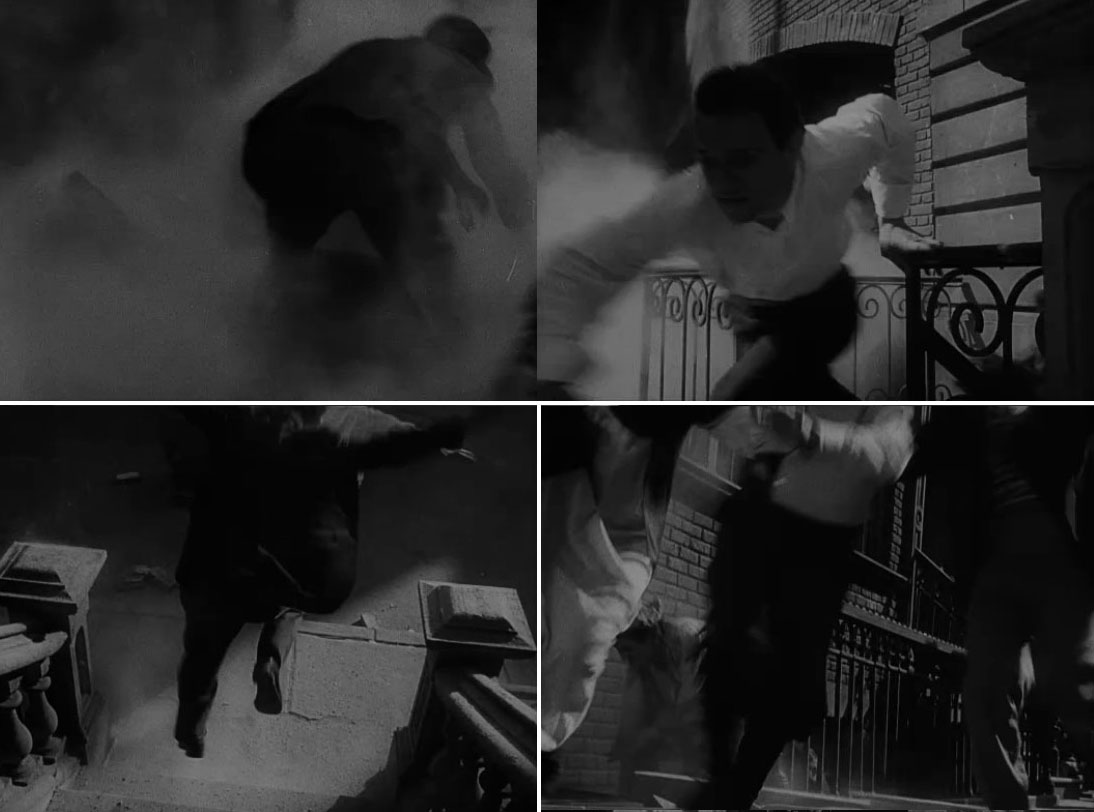
Not a big year for special effects. The winner featured an earthquake and a flood, both of which had been done with more spectacle in San Francisco and The Rains Came. Sisters Marianne (Lana Turner) and Marguerite (Donna Reed) both fall in love with the same man (Richard Hart), and through a series of mishaps all of them wind up in New Zealand with Van Heflin, where an earthquake, a tsunami, and a Maori uprising complicate things. This galumphing, improbable saga, based on a plot-heavy novel by Elizabeth Goudge, was hugely hyped by MGM, who were trying to make a star of the rather wimpy Hart. (They failed.) All of the effects people were multiple Oscar winners except for Steinore; this was his only win.    

Best Special Effects, 1944

Awards presented March 15, 1945
The nominees were ...

And the Oscar went to ... 

Gillespie won three Oscars in his almost thirty years as head of MGM's special effects department. I don't know where the fourth one displayed here came from.
A dated but watchable account of the first American bombing raids on Japan in World War II, with Spencer Tracy as Lt. Col. James Doolittle. Lots of the usual family tensions, pre-flight jitters, and do-or-die speechifying. The special effects rely heavily on miniatures, which were Jahraus's specialty. Gillespie joined MGM in 1925 and became head of the special effects department in 1936. He worked on both the 1925 Ben-Hur and its 1962 remake. This was the first of three Oscars for Gillespie and two for Newcombe, but the only one for Jahraus. Shearer accumulated nine awards, including technical citations, over his career as head of MGM's sound department.  

Best Sound, 1944

Awards presented March 15, 1945
The nominees were ...

... when they should have been ... 
And the Oscar went to ... 
Wilson. 20th Century-Fox Studio Sound Department, E.H. Hansen, Sound Director.

Darryl F. Zanuck log-rolls another win for his pet project, but it was still a flop. This was the second of Hansen's two Oscars, out of fourteen nominations. It's also the last credit listed on his Internet Movie Database entry, although he lived until 1962. Did he retire at just over fifty years old and rest on his laurels? It would be nice to know. 

... when it should have gone to ... 
Meet Me in St. Louis. Metro-Goldwyn-Mayer Studio Sound Department, Douglas Shearer, Sound Director.

MGM's fondness for Kismet, which it nominated instead of Meet Me in St. Louis for both sound and art direction, the categories in which it was limited to a single choice, is puzzling. It remade Kismet after the Broadway musical version was a success in 1955, giving it two of the Freed unit's best directors, Vincente Minnelli and Stanley Donen, though even that version isn't anything special and received no nominations. So I've replaced Kismet with a superior movie, which would have given Shearer another win -- not that he needed one. As for whether Meet Me in St. Louis deserved an award for sound? It had Judy Garland singing, didn't it?  

Best Sound, 1940

Awards presented February 27, 1941

The nominees were ... 

And the Oscar went to ... 
Strike Up the Band, Metro-Goldwyn-Mayer Studio Sound Department, Douglas Shearer, Sound Director. 

The second of the hey-kids-let's-put-on-a-show musicals (the first was Babes in Arms) starring Mickey Rooney and Judy Garland is all about trying to win an appearance in a national radio band concert featuring Paul Whiteman while at the same time trying to help a fellow band member pay for an operation. It has no relationship (other than the title song) to the Broadway musical by George and Ira Gershwin. Aside from some standards from the 1920s and earlier, most of the songs are by Roger Edens and Arthur Freed. This was one of the hits produced by Freed that led to the creation of the "Freed Unit," an independent musical film production division of MGM, in 1944. It was directed by Busby Berkeley, whose MGM production numbers were always more restrained than the ones he did at Warner Bros. 


Best Sound, 1936

Awards presented March 4, 1937

The nominees were ... 

And the Oscar went to ... 
San Francisco, Metro-Goldwyn-Mayer Studio Sound Department, Douglas Shearer, Sound Director. 
Shearer's unfortunately anonymous sound crew deserved the award, not just for recording Jeanette MacDonald, but mainly for the sound effects supplied for the earthquake sequence, which is probably the only reason anyone watches the film today. 
Jeanette MacDonald auditions for Clark Gable in San Francisco
The aftermath of the quake in San Francisco
 The visuals for the earthquake sequence were supervised by James Basevi and edited by Slavko Vorkapich. The special effects category had not yet been returned to the awards, so neither was nominated. A case could have been made for nominating Vorkapich for editing, however, but he wasn't included among the nominees.


Best Sound, 1935

Awards presented March 5, 1936

The Academy was still indicating who placed second and third. Captain Blood came in second and The Lives of a Bengal Lancer was third.

The nominees were ... 

And the Oscar went to ... 
Naughty Marietta, Metro-Goldwyn-Mayer Studio Sound Department, Douglas Shearer, Sound Director. 
Producer Hunt Stromberg presents the Oscar for Naughty Marietta to Douglas Shearer
Jeanette MacDonald and Nelson Eddy in Naughty Marietta 
The first teaming of MacDonald with Eddy was a big success, although those of us who love the MacDonald-Chevalier teaming at Paramount look on it as a step down for her. It's based on the operetta by Victor Herbert, and features some of the songs for which the duo were celebrated (or at least lampooned): "Ah, Sweet Mystery of Life," "The Italian Street Song" (you know, the one with the refrain that goes "Zing, zing, zizzy, zizzy, zing, zing, boom, boom, ay" -- and now try to get that out of your head), "I'm Falling in Love With Someone," and "Tramp! Tramp! Tramp! (Along the Highway)."  It's actually better than you might think. Eddy was always a block of wood, but MacDonald still has some of the wit she always showed with Chevalier.  

Best Sound, 1929-30

Awards presented November 5, 1930
(Films released from August 1, 1929 through July 31, 1930 were eligible.)

Its time had come, and the Academy knew it, creating a new Oscar category for sound recording. As the technology changed and improved, subcategories would be added for sound mixing and sound editing. Individual sound technicians would be nominated, too, but at first the Academy simply gave the award to the studio sound department, and if it named names, it would be the department head, who may or may not have had anything directly to do with the film designated in the award. Controversy has rarely arisen over this award, but when it did I'll be sure to tell you. 


The nominees were ... 

And the Oscar went to ...
Norma and Douglas Shearer
The Big House. It was a good year for the Shearers: Douglas Shearer was best actress winner Norma's brother. He had followed Norma to Hollywood and found a job at MGM, which was gearing up for sound. Although he had no previous training in working with sound equipment, he picked it up quickly and became one of the film industry's most important innovators. He (or he and his department) was nominated twenty-one times and won seven Oscars, plus another seven of the Academy's scientific or technical awards.